7 Practical Ways AI Improves Supply Chain Decisions
7 Practical Ways AI Improves Supply Chain Decisions
Jun 28, 2026
TL;DR: AI in Supply Chain Management Is About Better Decisions, Not Just Better Technology
Artificial intelligence is becoming a serious part of supply chain management, but the real value is not in the technology by itself.
The value comes when AI helps leaders make better decisions. That means improving how teams forecast demand, manage inventory, prioritize exceptions, respond to supplier risk, reduce cost-to-serve, and connect supply chain actions to financial outcomes.
AI can help supply chain teams read signals faster, identify risk earlier, and recommend actions with more context. But it does not replace supply chain judgment. It does not fix broken processes by itself. And it does not create value if teams use it only to generate more dashboards.
The best AI use cases are grounded in business reality. They improve decisions that affect service, cost, working capital, margin, execution, and resilience.
This article explores seven practical ways AI can improve supply chain decisions and what leaders should consider before rolling it out across the business.
Why Supply Chain Leaders Are Asking How AI Can Be Used in SCM
Supply chain leaders are operating in a more complex environment than they were even a few years ago.
Demand shifts faster. Supplier performance is less predictable. Transportation costs remain volatile. Customers expect better service. Finance teams want tighter control of working capital. Commercial teams want more availability. Operations teams are expected to execute with fewer delays, fewer surprises, and less waste.
That creates a difficult reality.
Supply chain teams are being asked to move faster, but many are still relying on planning cycles, reports, spreadsheets, and decision processes that were designed for a slower world.
This is where AI can help.
Not because it is fashionable. Not because every organization needs another technology project. AI becomes useful when it reduces decision latency, improves visibility, strengthens control, and helps teams choose better actions under real constraints.
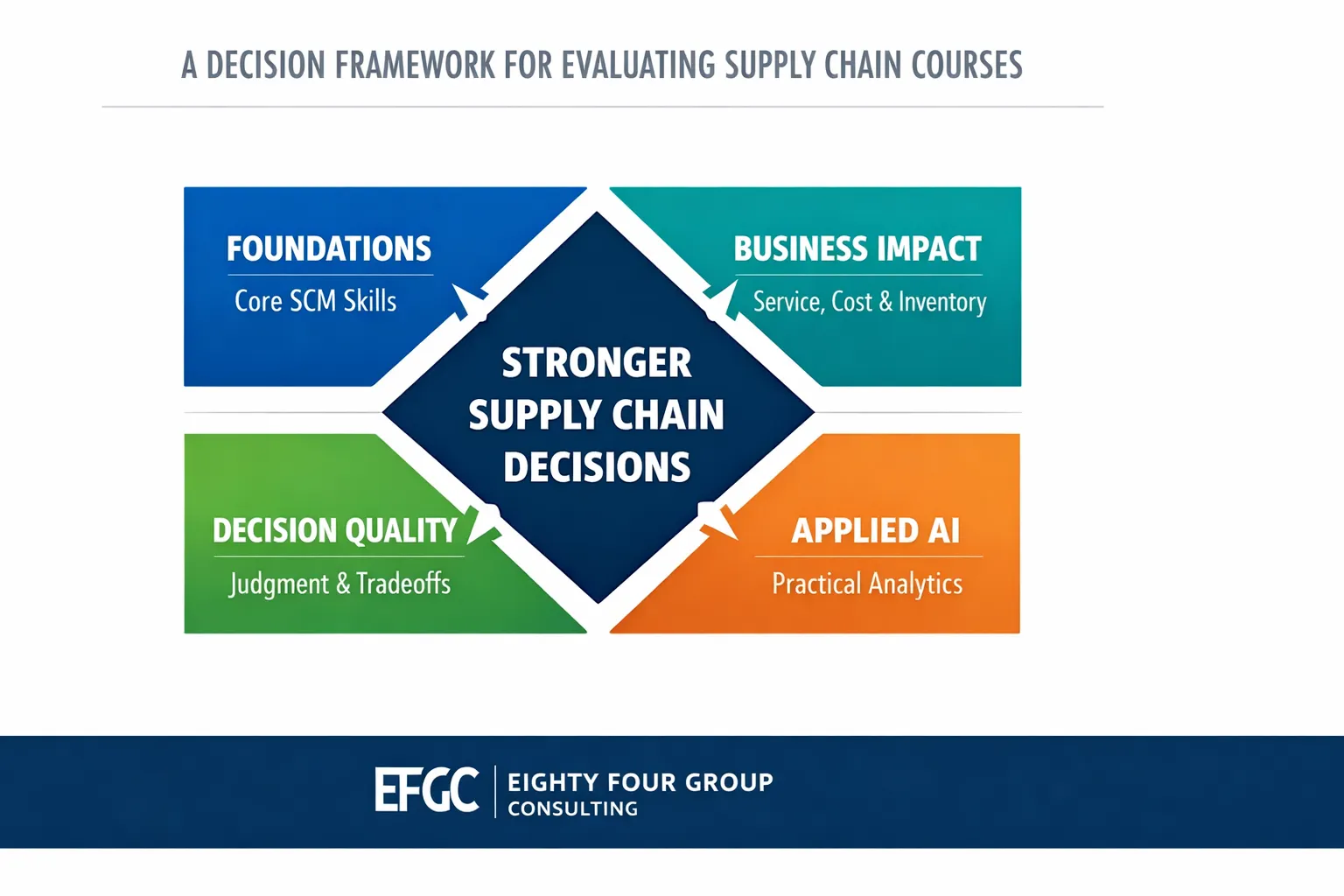
That is also the practical focus behind Eighty Four Group Consulting’s approach to AI for supply chain management: stronger supply chain decisions grounded in business reality.
The question is not simply, “Where can we use AI?”
The better question is:
Where are our supply chain decisions too slow, too reactive, too manual, or too disconnected from business impact?
That is where AI should start.
1. AI Improves Forecasting and Demand Planning Decisions
Forecasting is one of the most important supply chain activities because so many decisions depend on it.
Inventory levels, replenishment plans, production schedules, procurement orders, warehouse capacity, transportation needs, and customer commitments all rely on some view of future demand.
The problem is that demand rarely behaves politely. Promotions shift demand. Social media can create sudden spikes. Competitor activity changes buying patterns. Weather, economic conditions, customer behavior, and channel changes can all affect what customers want and when they want it.
Traditional forecasting methods often depend heavily on historical data and periodic review cycles. That can work in stable environments. It struggles when demand changes quickly.
AI helps teams read demand signals earlier and faster.
AI can analyze a wider range of demand signals, including sales trends, promotions, seasonality, customer behavior, weather, channel activity, market trends, and other external indicators. Instead of waiting for the next monthly planning cycle, AI-supported demand sensing can help planners identify changes earlier.
That matters because the forecast itself is not the business result. The result comes from what the organization does next.
Do you increase replenishment? Transfer inventory? Adjust safety stock? Change allocation? Protect a key customer segment? Slow down a purchase order? Prepare the warehouse for higher volume?
AI improves forecasting when it helps teams act sooner and with better context.
AI helps planners focus on exceptions. Given many planning teams spend too much time reviewing too many lines.
AI can help identify where human attention is most needed: unusual demand spikes, forecast bias, product launch anomalies, abnormal orders, demand drops, or inventory risks. That creates a more practical planning process.
The planner does not need to manually touch every SKU. The planner needs to focus on the decisions where judgment matters.
The takeaway
AI can make forecasting more responsive, but humans still own the business context. Customer knowledge, commercial priorities, supply constraints, margin considerations, and strategic tradeoffs still require human judgment.
The strongest forecasting processes combine AI-supported pattern recognition with experienced supply chain decision-making.
2. AI Improves Inventory and Working Capital Decisions
Inventory is not just stock sitting in a warehouse. It is cash. It is service. It is risk. It is margin. It is optionality. It is also one of the most visible places where supply chain decisions show up on the balance sheet.
Too little inventory can create stockouts, missed revenue, service failures, and customer frustration. Too much inventory can trap cash, increase carrying costs, create markdown risk, and hide deeper planning problems.
The goal is not to hold more inventory.
The goal is to hold the right inventory, in the right place, for the right reason, with a clear understanding of the tradeoff being made. That idea sits closely with the Glass Cockpit perspective behind Profitability Now: better supply chain decisions require better visibility, stronger controls, and closer alignment to business priorities.
AI identifies inventory risk earlier.
AI can help teams detect excess inventory, stockout risk, slow-moving exposure, aging inventory, and location imbalances earlier than traditional reporting. That matters because inventory problems are easier to correct before they become urgent.
If a product is building excess stock, teams may still have time to adjust replenishment, slow future purchases, transfer inventory, change promotional support, or review pricing. If a stockout risk is emerging, teams may still have time to expedite selectively, allocate inventory, adjust customer promises, or source alternatives.
AI becomes valuable when it helps teams see these risks soon enough to act.
AI improves replenishment and allocation decisions.
AI can also support replenishment priorities, inventory transfers, safety stock updates, allocation rules, and inventory positioning. This is especially important for organizations with multiple channels, locations, customer segments, or product families.
The same inventory position can mean different things depending on margin, customer priority, lead time, demand volatility, and substitution options. A simple “days of supply” view is not enough.
AI can help connect inventory decisions to service, cash, and margin impact.
The takeaway
Inventory AI should not be measured only by forecast accuracy or stock level reduction.
It should be measured by better business tradeoffs.
The real question is whether AI helps the organization improve service, protect working capital, reduce avoidable cost, and make inventory decisions that support the broader business strategy.
3. AI Improves Warehouse and Fulfillment Execution Decisions
Warehouse operations are where supply chain plans become real. A forecast may look good. A replenishment plan may be approved. A customer promise may be made. But if warehouse labor, slotting, dock flow, inventory accuracy, and fulfillment execution are not aligned, the plan does not matter.
Warehouses are under pressure from higher order volumes, labor constraints, more complex fulfillment requirements, and shorter customer expectations. Many teams are not short on effort. They are short on decision support.
AI supports labor planning and warehouse flow.
AI can help forecast inbound volume, outbound volume, returns activity, dock demand, labor needs, and peak-period workload. That gives warehouse leaders a better view of what is coming. Instead of reacting after the floor is already congested, supervisors can adjust staffing, equipment, wave planning, dock scheduling, and workload balancing earlier. This is where AI supports execution cadence.
The goal is not simply to know that work is increasing. The goal is to make better operational decisions before the warehouse becomes the bottleneck.
AI improves slotting, picking, and exception handling.
AI can also support dynamic slotting, pick-path optimization, replenishment within the warehouse, and exception management. For example, AI can help identify products that should be relocated based on velocity, order patterns, seasonality, or labor impact. It can also help identify inventory discrepancies, delayed orders, damaged goods, or process exceptions that may affect customer service.
The practical value is not more reporting. The value is fewer avoidable delays, better flow, and better use of labor and space.
The takeaway
Warehouse AI works best when it improves execution discipline.
A stronger warehouse decision environment helps teams anticipate constraints, prioritize work, and respond before small issues become customer-facing failures.
4. AI Improves Transportation, Routing, and Cost-to-Serve Decisions
Transportation is one of the most expensive and variable parts of the supply chain.
It affects cost, service, customer experience, margin, and operational reliability.
Transportation decisions are rarely simple. Leaders often have to balance cost, speed, reliability, capacity, customer requirements, and disruption risk at the same time. That is exactly where AI can help.
AI supports routing, carrier selection, and delivery promise accuracy.
AI can evaluate carrier performance, transit times, capacity availability, fuel costs, lane reliability, delivery windows, weather, traffic, and customer service requirements. This helps logistics teams make better routing and carrier decisions. The cheapest option is not always the best option. The fastest option is not always the smartest option. The best decision depends on the business promise being protected and the cost of failure.
AI can also help improve delivery promise accuracy by monitoring shipment progress and network conditions more dynamically. That matters because poor delivery promises create downstream cost: customer service contacts, refunds, re-ships, expedited freight, lost trust, and operational rework.
AI reduces freight exceptions and expedite costs.
AI can help identify transportation risks earlier, including missed pickups, capacity shortages, delayed shipments, route disruptions, accessorial risk, or carrier performance issues. Early warning gives logistics teams more options. A delay identified late often becomes an expedite. A delay identified early may become a route change, customer communication, load reallocation, or inventory transfer.
That is how AI can reduce cost-to-serve without damaging service.
The takeaway
Logistics AI should protect the service promise while lowering cost-to-serve.
The goal is not just freight savings. The goal is better transportation decisions that balance cost, reliability, speed, and customer impact.
5. AI Improves Procurement, Supplier Risk, and Supply Continuity Decisions
Procurement is no longer only about purchase price. Procurement decisions affect supply continuity, margin protection, inventory availability, working capital, quality, compliance, and resilience. In a more volatile supply environment, organizations need earlier warning when supplier risk is building. They also need a better way to connect supplier performance to operational and financial impact.
AI monitors supplier performance and risk signals.
AI can help monitor supplier performance indicators such as on-time delivery, lead-time variability, quality performance, capacity concerns, price movement, and order reliability. It can also help evaluate external risk signals such as geopolitical disruption, trade restrictions, weather events, financial stress, labor issues, and regional instability. The point is not to create a long list of alerts. The point is to help procurement and supply chain teams identify which risks matter most and what action should be taken.
AI improves purchase order and inbound supply visibility.
AI can also help monitor purchase orders, supplier commitments, shipment milestones, material availability, and inbound logistics risk. It can flag late orders, incomplete supplier updates, constrained materials, transportation delays, and other issues that may affect production, fulfillment, or customer service.
When disruption occurs, AI can also support evaluation of alternatives: substitute materials, alternate suppliers, split orders, priority allocations, or adjusted customer commitments.
The takeaway
Procurement AI should improve resilience, not just automate buying. The value is in better risk sensing, stronger supplier visibility, and faster decisions when supply continuity is threatened.
6. AI Improves Control Tower and End-to-End Visibility Decisions
Many organizations have invested in dashboards, visibility platforms, and control towers. That visibility is useful, but visibility alone does not improve performance.
Knowing that a shipment is delayed, a product is short, or a supplier is late is only the first step. Leaders also need to know the business impact, the priority level, the decision owner, and the best available action.
This is why the next evolution of control towers is not simply more visibility.
It is better decision support.
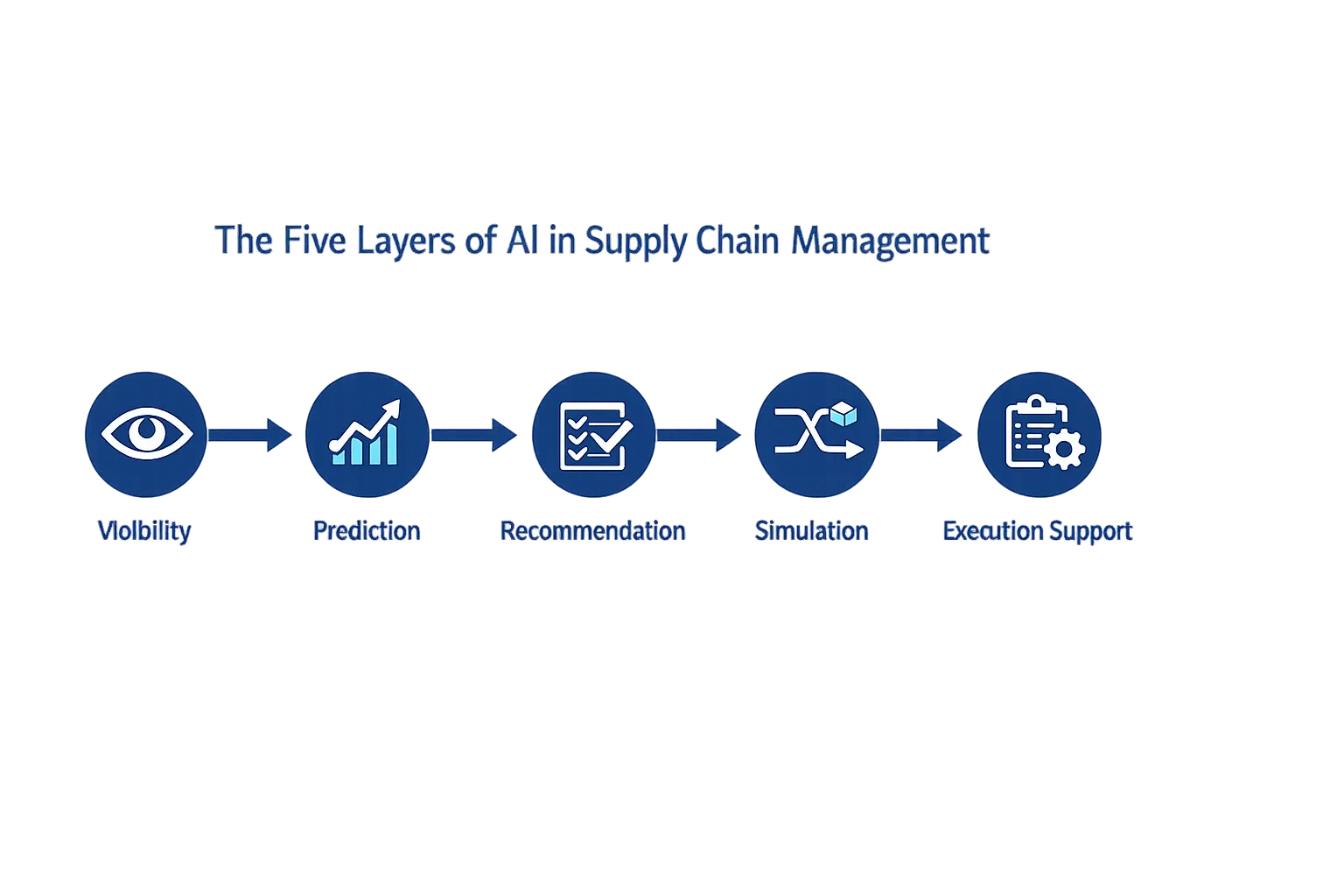
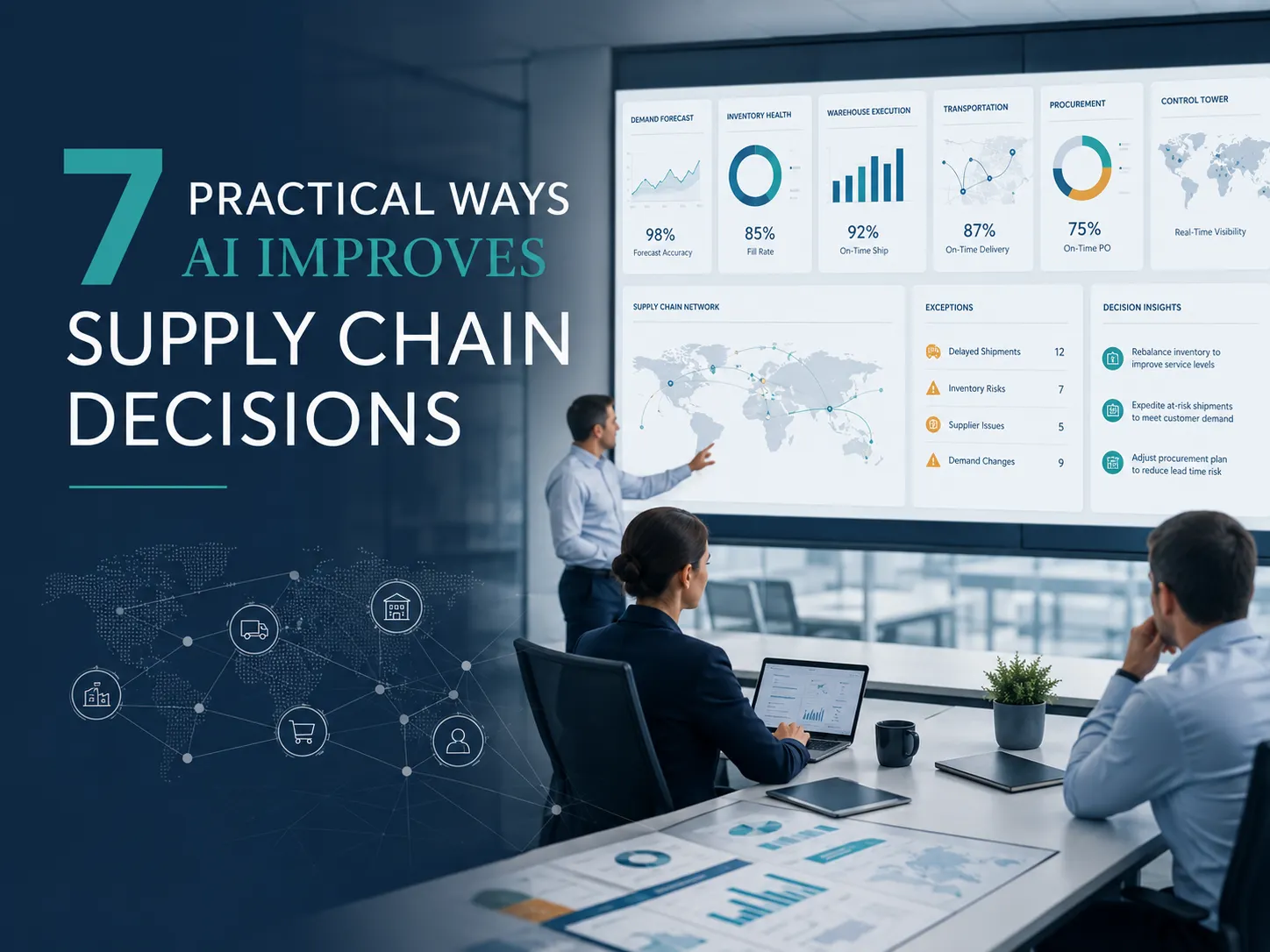
AI turns visibility into prioritized action.
AI can help evaluate the likelihood and impact of disruptions across the supply chain. Instead of giving teams hundreds of alerts, AI can help prioritize the issues that affect revenue, margin, service, cash, or customer commitments. A late shipment for a low-priority item may not need the same response as a late shipment that threatens a strategic customer, a high-margin product, or a critical launch.
AI can help rank exceptions by business impact.
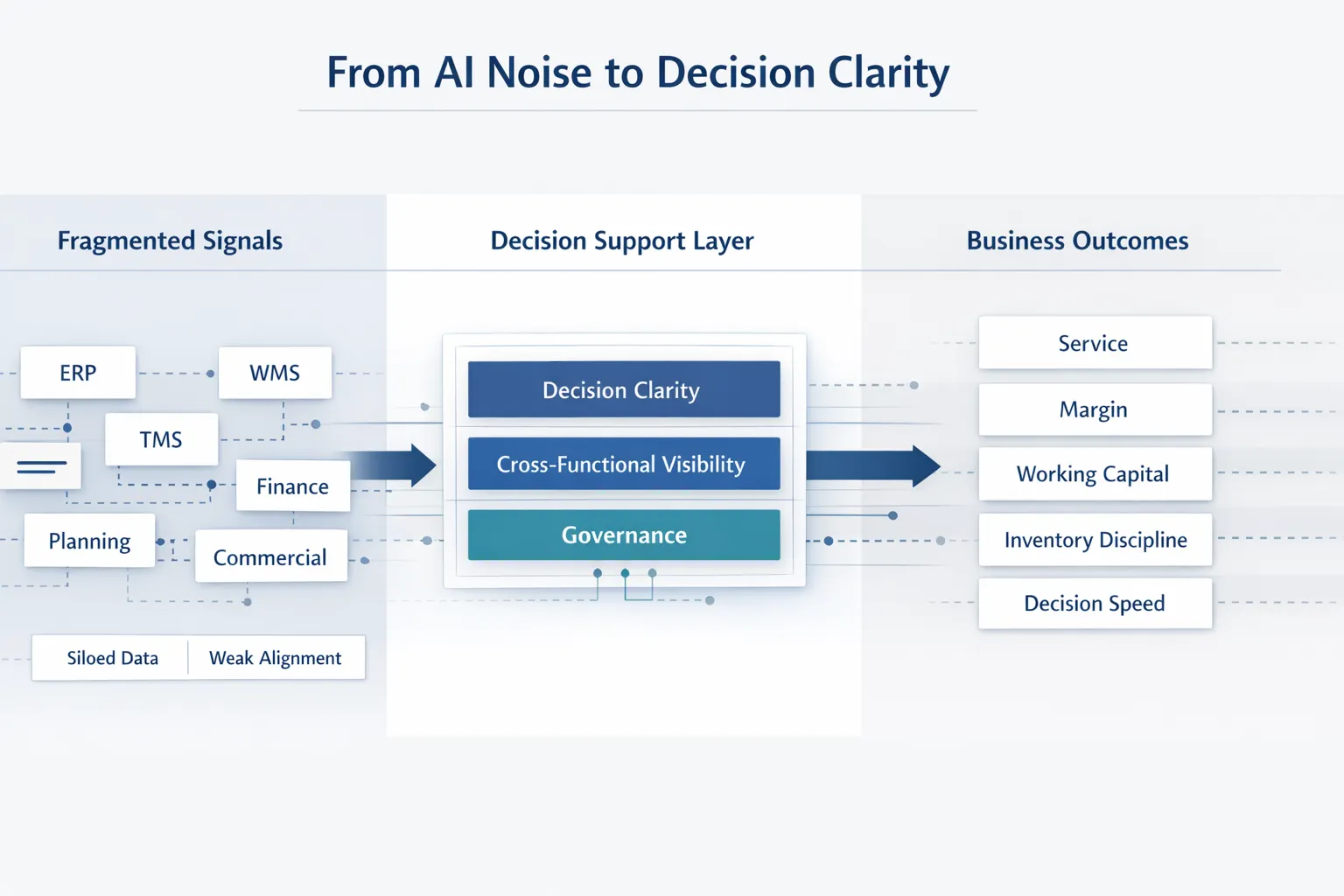
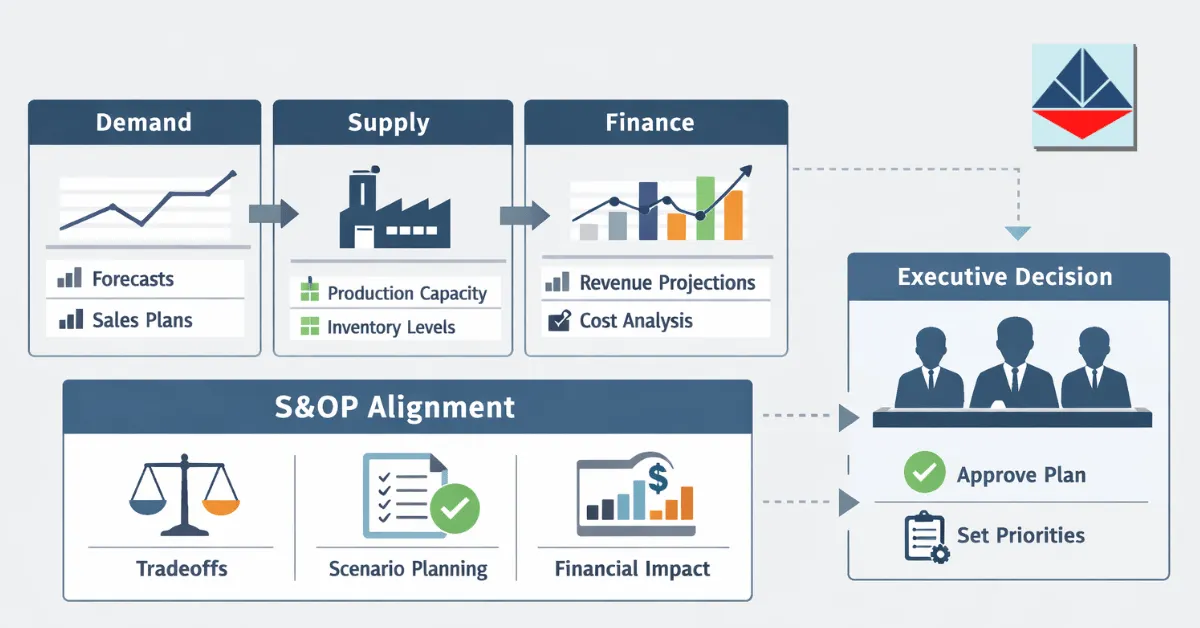
That is where control towers begin to become decision towers. AI connects planning, inventory, logistics, procurement, and finance as supply chain decisions rarely sit inside one function. A supplier delay can create inventory risk. Inventory risk can affect customer orders. Customer orders can affect revenue. Expedites can protect service but hurt margin. Replenishment decisions can protect availability but trap cash.
AI can help connect these signals into a more complete operating view.
That is also the direction behind the AI-powered supply chain operating solution being developed by Eighty Four Group Consulting: a decision support layer that connects daily execution, planning priorities, and financial impact.
The takeaway
Control towers must become decision towers.
Visibility is useful, but decision support is where value is created. The future of control towers is not just seeing what happened. It is understanding what matters, what to do next, who owns the response, and what business impact is at stake.
7. AI Improves Scenario Planning and Decision Simulation
One of the most practical AI use cases in supply chain management is scenario planning. Supply chain leaders rarely make decisions in perfect conditions. They make decisions under uncertainty.
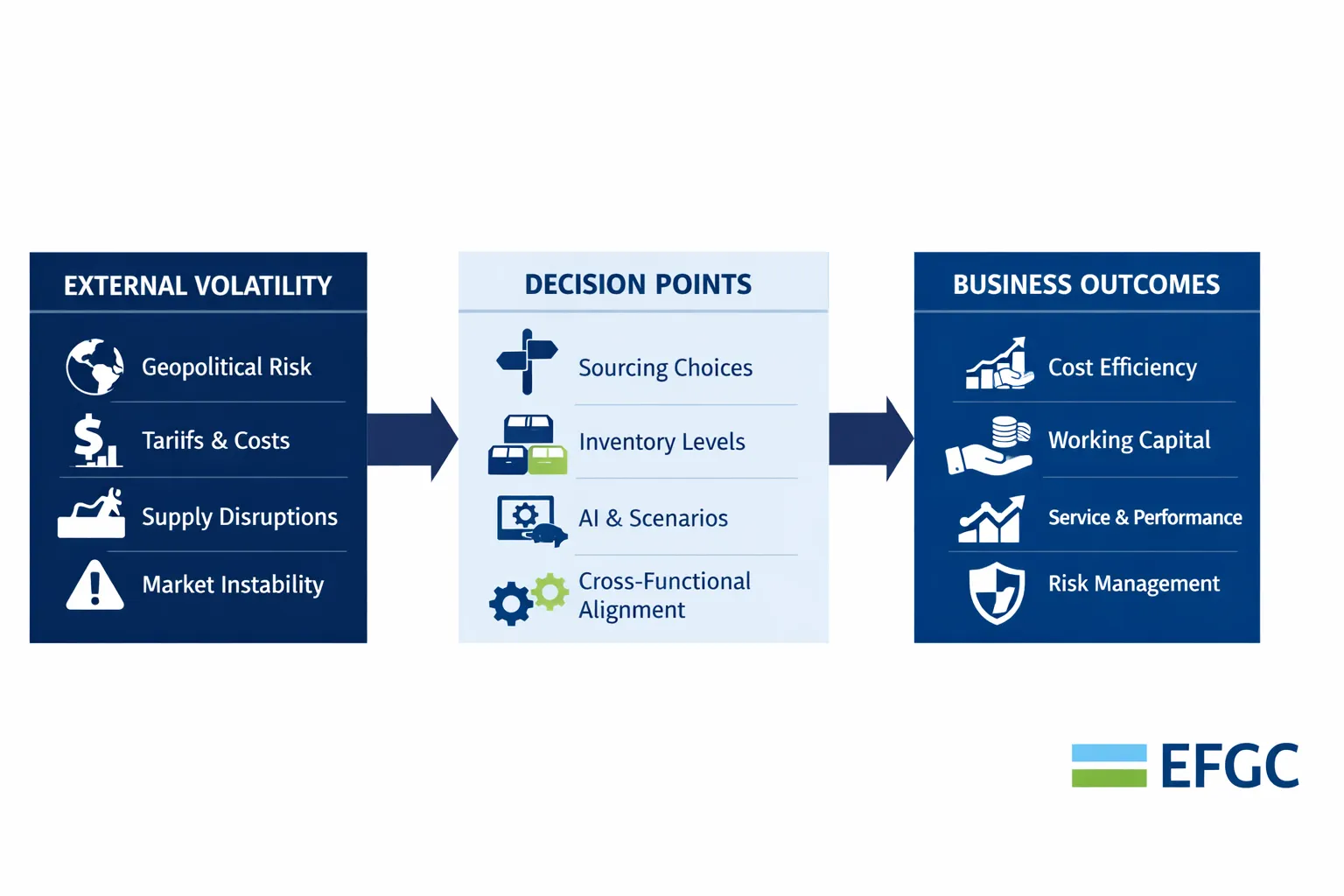
What happens if demand increases by 15 percent? What happens if a supplier misses two weeks of production? What happens if a tariff change affects a key product family? What happens if transportation capacity tightens? What happens if a major customer changes the order pattern?
Traditional planning often struggles with these questions because the business does not have enough time, clean data, or cross-functional alignment to test options quickly. AI can improve that process.
AI helps leaders compare possible actions.
AI can help teams evaluate scenarios and compare possible responses.
For example:
• Should we transfer inventory or place a new purchase order?
• Should we expedite freight or accept a service delay?
• Should we allocate inventory to the highest-margin channel or the highest-priority customer?
• Should we delay replenishment to protect cash?
• Should we liquidate slow-moving stock to release working capital?
• Should we approve a substitute supplier?
• Should we adjust service promises by customer segment?
These are not technology questions. They are business tradeoff questions.
AI becomes useful when it helps leaders compare options more quickly and understand the likely impact on service, cost, cash, margin, and risk.
AI strengthens learning through simulation.
Scenario-based learning can also help leaders, teams, and students understand how supply chain decisions affect business performance. That is the purpose behind EFGC’s ROCE Business Game, which uses disruption scenarios and decision comparisons to show how traditional and AI-supported decisions can affect operational and financial outcomes.
The same principle applies inside companies. Teams improve when they can see the consequences of different decisions before those decisions become expensive in the real world.
The takeaway
Scenario planning is one of the clearest places where AI can support better decision quality. AI should help leaders move beyond static plans and into faster, more financially grounded decision comparisons.
What Supply Chain Leaders Should Do Before Rolling Out AI
AI can improve supply chain decisions, but only if the organization prepares the right way. Many AI projects under-deliver because they start with the tool instead of the business decision. That is the wrong starting point.
The better starting point is to identify the decisions that are too slow, too manual, too reactive, or too disconnected from business performance. That is also why many AI for SCM projects fail to solve the real problem: they target technology activity instead of decision quality. For a deeper view on that issue, see Why Most AI for Supply Chain Fails to Solve the Real Problem.
Start with the decision, not the AI tool.
Leaders should first identify where decision quality matters most.
Examples include:
• demand planning
• inventory allocation
• replenishment
• supplier risk response
• transportation exception management
• customer order prioritization
• warehouse labor planning
• scenario planning
• working capital tradeoffs
Then they should define what better looks like.
Does better mean faster decisions? Lower inventory exposure? Better service reliability? Lower expedite costs? Better forecast response? Improved ROCE? Stronger cross-functional alignment? Without that clarity, AI becomes activity without direction.
Build the data foundation and governance model.
AI needs reliable data, but it does not need perfect data before any progress can begin. What it does need is decision-grade data. That means clear definitions, trusted sources, ownership, update routines, and visibility into where data is strong or weak.
Organizations also need governance.
Who can approve AI-supported recommendations? Who can override them? How are overrides tracked? How often are decision rules reviewed? Who owns model performance after launch? What happens when the business changes? AI in supply chain management cannot be “set it and forget it.” It has to be managed as part of the operating model.
Prepare people for AI-supported decisions.
AI adoption is not only a technology issue. It is also a skills and behavior issue.
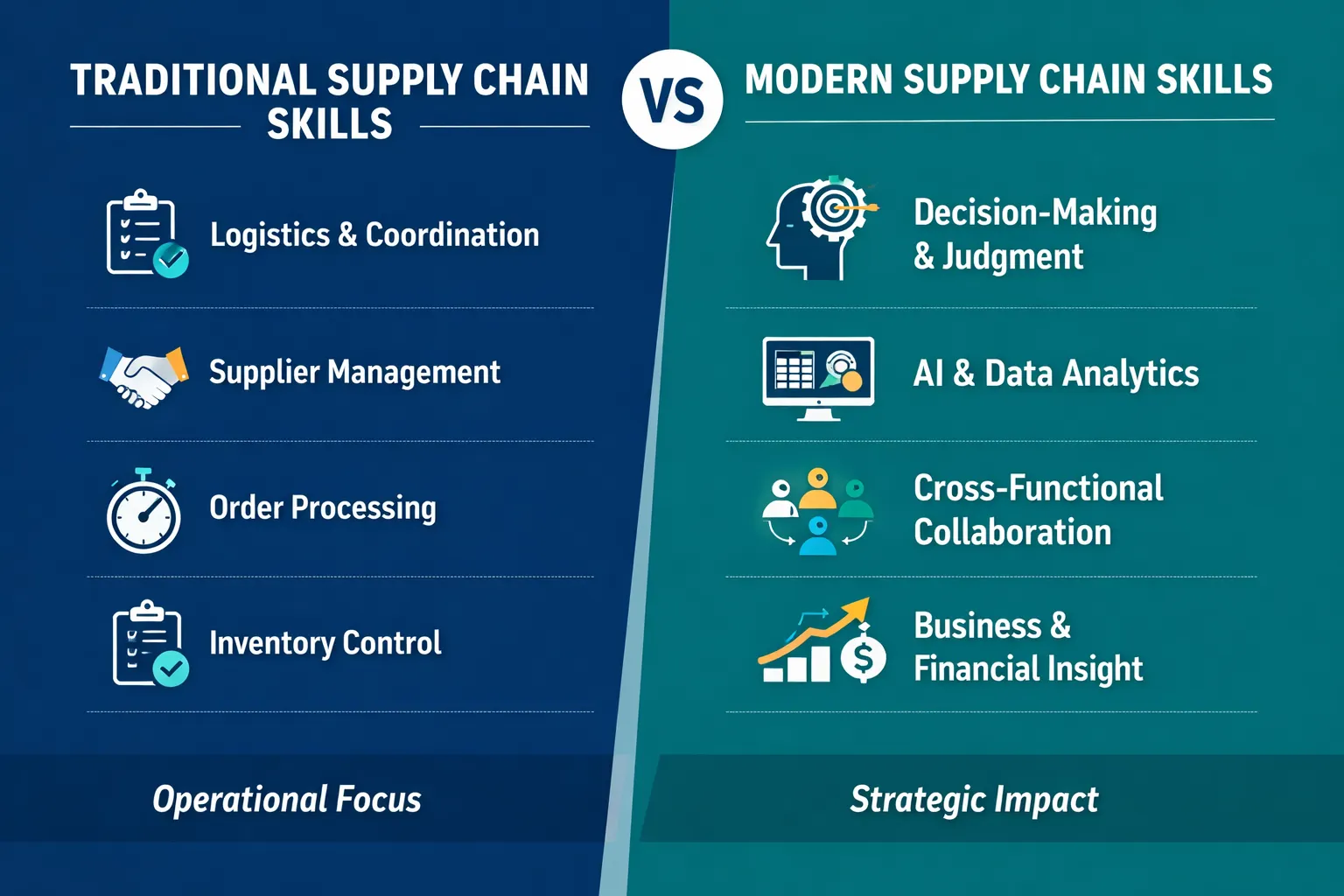
Supply chain professionals need to understand where AI helps, where it does not, how to question outputs, and how to connect recommendations to real business tradeoffs. That is why practical education matters.
EFGC’s Applied AI for Supply Chain Management Course is designed around this kind of practical understanding: connecting inventory, operations, finance, and decision-making in a way that is grounded in business reality.
The goal is not to turn every supply chain professional into a data scientist. The goal is to help teams become stronger AI-enabled decision-makers.
The takeaway
AI rollout is an operating model project.
It requires business ownership, cross-functional alignment, data discipline, governance, change management, and practical education. The technology matters. But the operating model determines whether the technology creates value.
Conclusion: The Future of AI in Supply Chain Belongs to Better Decision-Makers
AI is already changing supply chain management.
It can improve forecasting, inventory management, warehouse execution, transportation decisions, supplier risk monitoring, control tower visibility, and scenario planning.
But AI is not the advantage by itself.
The advantage belongs to organizations that know how to turn signals into decisions and decisions into better execution. AI can identify patterns. It can detect risk. It can prioritize exceptions. It can recommend actions. It can help teams understand tradeoffs faster. But leaders still need to decide what matters. They still need to align the business. They still need to manage service, cost, cash, margin, and risk. They still need to govern the process. They still need to ensure that AI-supported decisions match the operating reality of the business.
That is why the future of AI in supply chain management belongs to operators, leaders, and organizations that can combine technology with judgment.The goal is not more AI.The goal is clearer decisions, stronger controls, better visibility, and measurable business impact.
If your organization is exploring how AI can improve supply chain decisions, start with the decisions that matter most. Then build the visibility, governance, and operating discipline needed to act on them.
To explore how Eighty Four Group Consulting helps organizations improve supply chain decision quality, visit AI for Supply Chain Management Solutions or contact Eighty Four Group Consulting to start a conversation.