Sales and Operations Planning Process: How to Improve Decision Clarity, Alignment, and Business Performance
Sales and Operations Planning Process: How to Improve Decision Clarity, Alignment, and Business Performance
Jun 03, 2021
by: Corey Weekes
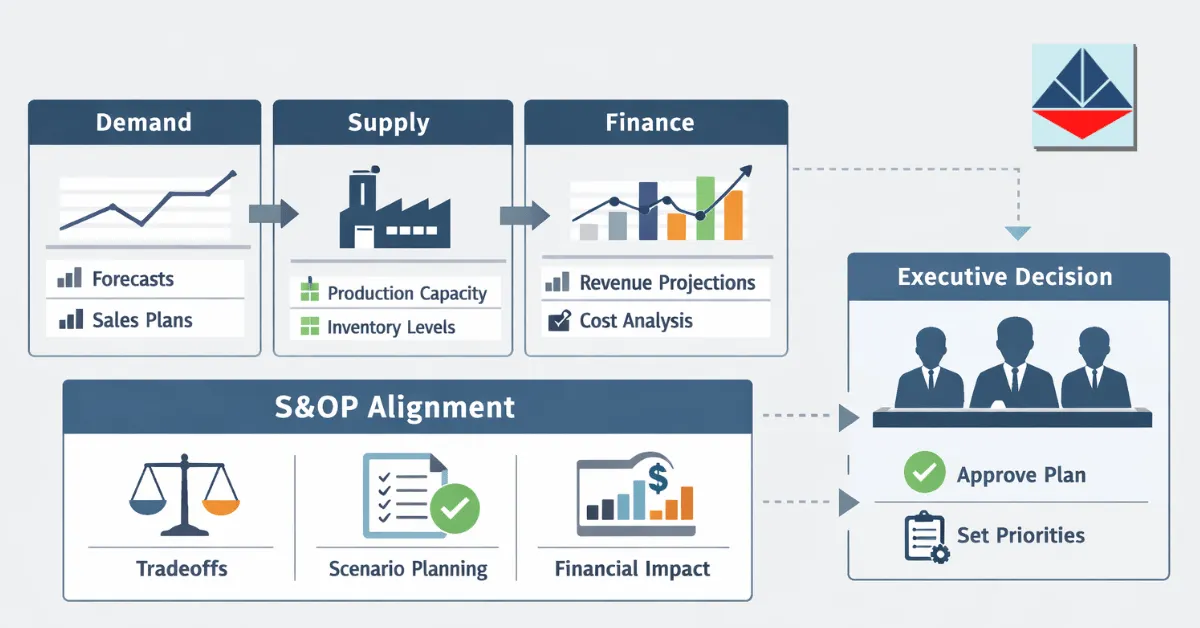
The sales and operations planning process is meant to help a business align demand, supply, inventory, capacity, and financial goals. In many organizations, though, S&OP turns into a monthly reporting routine instead of a real decision and EBIT driving process. Teams bring different numbers. Finance joins too late. Tradeoffs stay unresolved. Decisions are delayed, revisited, or made without a clear view of business impact. That is where performance starts to drift. Oracle defines S&OP as an integrated business management process that helps organizations balance supply and demand while connecting operational plans to financial outcomes.
A stronger S&OP process does more than balance plans. It improves decision clarity across functions. It helps leadership see tradeoffs sooner, make better business-aligned choices, and connect operational plans to service, cost, inventory, working capital, and margin. In operating reality, that is what good planning is for. Kinaxis and Anaplan similarly position S&OP as a cross-functional business process that aligns plans and supports executive decision-making.
TL;DR
- The sales and operations planning process is a cross-functional process used to align demand, supply, inventory, capacity, and financial goals.
- Good S&OP is not just a monthly meeting. It is a decision system for resolving tradeoffs before they become service, cost, or inventory problems.
- It works best when sales, operations, supply chain, and finance are working from a shared view of the business.
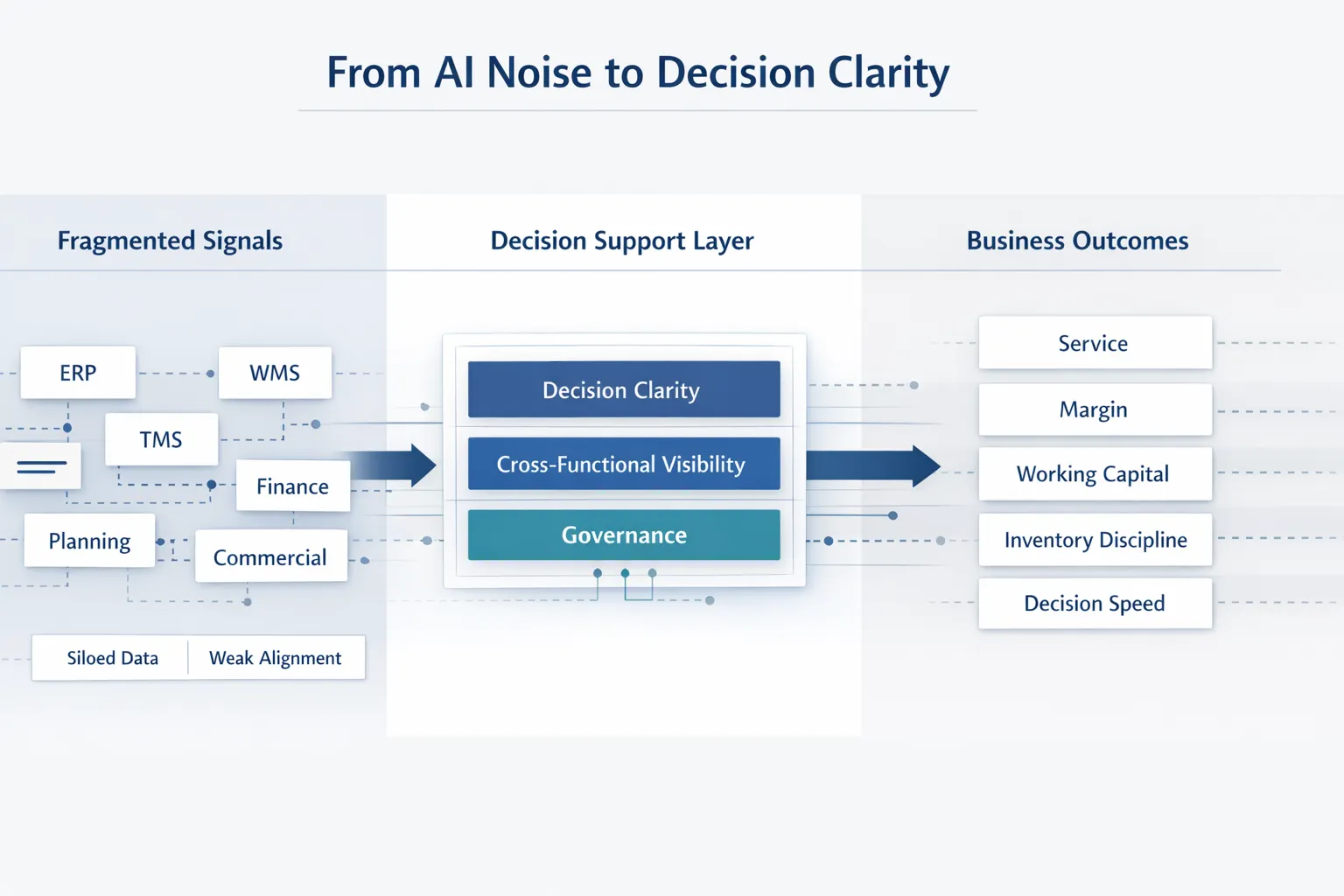
- Many S&OP processes underperform because they rely on siloed data, spreadsheet-heavy prep, stale assumptions, and weak executive decision discipline.
- A modern S&OP process should improve decision speed, decision confidence, cross-functional alignment, inventory discipline, and financial visibility.
- AI can help by improving scenario comparison, highlighting exceptions, and reducing decision latency, but only when it supports real business decisions rather than adding more noise.
- If your current process feels slow, fragmented, or disconnected from finance, Take the Diagnostic.
What is the sales and operations planning process?
The sales and operations planning process is a structured, recurring process used to align commercial demand, operational capability, and financial expectations. At its core, it helps leaders answer a practical question: given what we expect the market to demand, what can we supply, what will it cost, what inventory will it require, and what tradeoffs do we need to make? Oracle, Kinaxis, and Anaplan all describe S&OP as a recurring, cross-functional planning and decision process tying together supply, demand, and business objectives.
That definition matters because S&OP is often reduced to a supply chain planning exercise. It is broader than that. Oracle describes S&OP as an integrated planning process that aligns demand, supply, and financial planning for executive decision-making. Kinaxis frames it as a regularly scheduled process involving finance, sales, marketing, and planners across demand, supply, inventory, and capacity. Anaplan similarly positions it as a business decision process that connects plans and strategies across the business.
A good S&OP process gives the business one coherent view of the future. It does not remove uncertainty. It improves how the organization responds to uncertainty by making tradeoffs more visible, comparable, and easier to resolve.
Why the Sales and Operations Planning Process Matters
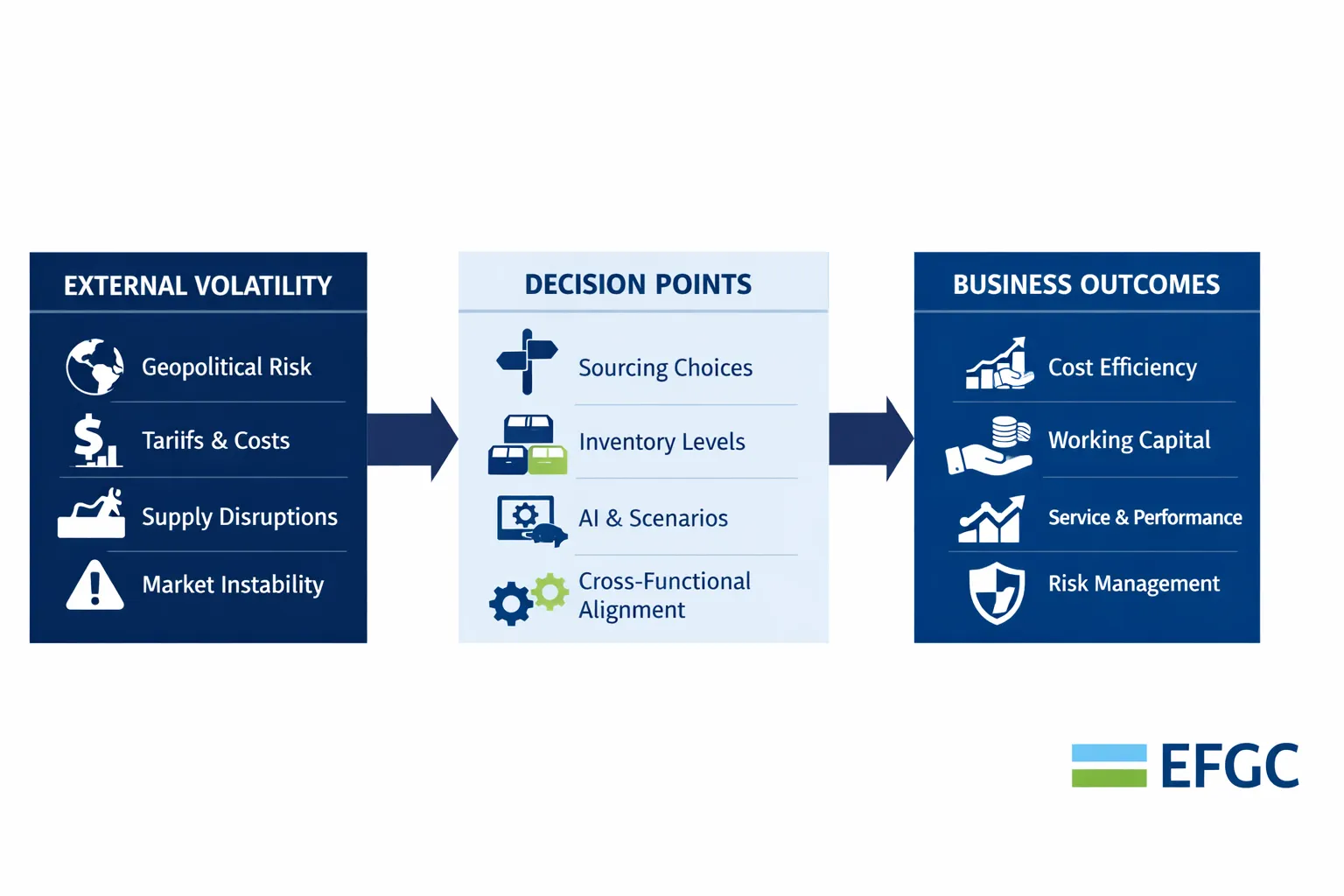
Most businesses do not struggle because they lack meetings. They struggle because important decisions are made with partial visibility, conflicting assumptions, and weak alignment across functions. That is exactly where a strong sales and operations planning process creates value.
It helps commercial teams, operations teams, supply chain leaders, and finance leaders work from the same operating picture. It makes it easier to see the consequences of pushing volume, carrying more stock, protecting service, constraining capacity, or absorbing cost. It creates a forum where the business can make deliberate choices instead of drifting into them. Oracle and Kinaxis both emphasize alignment and better business decisions as core benefits of S&OP.
When S&OP is working well, the benefits show up in practical ways: better forecast quality, clearer accountability, stronger inventory discipline, lower working capital drag, better service performance, and fewer escalations caused by surprises that should have been surfaced earlier. Kinaxis notes stronger alignment, forecast quality, inventory cost reduction, working capital improvement, and on-time delivery as S&OP outcomes. Anaplan also emphasizes profitability and synchronized decision-making.
The Business Value of Better S&OP
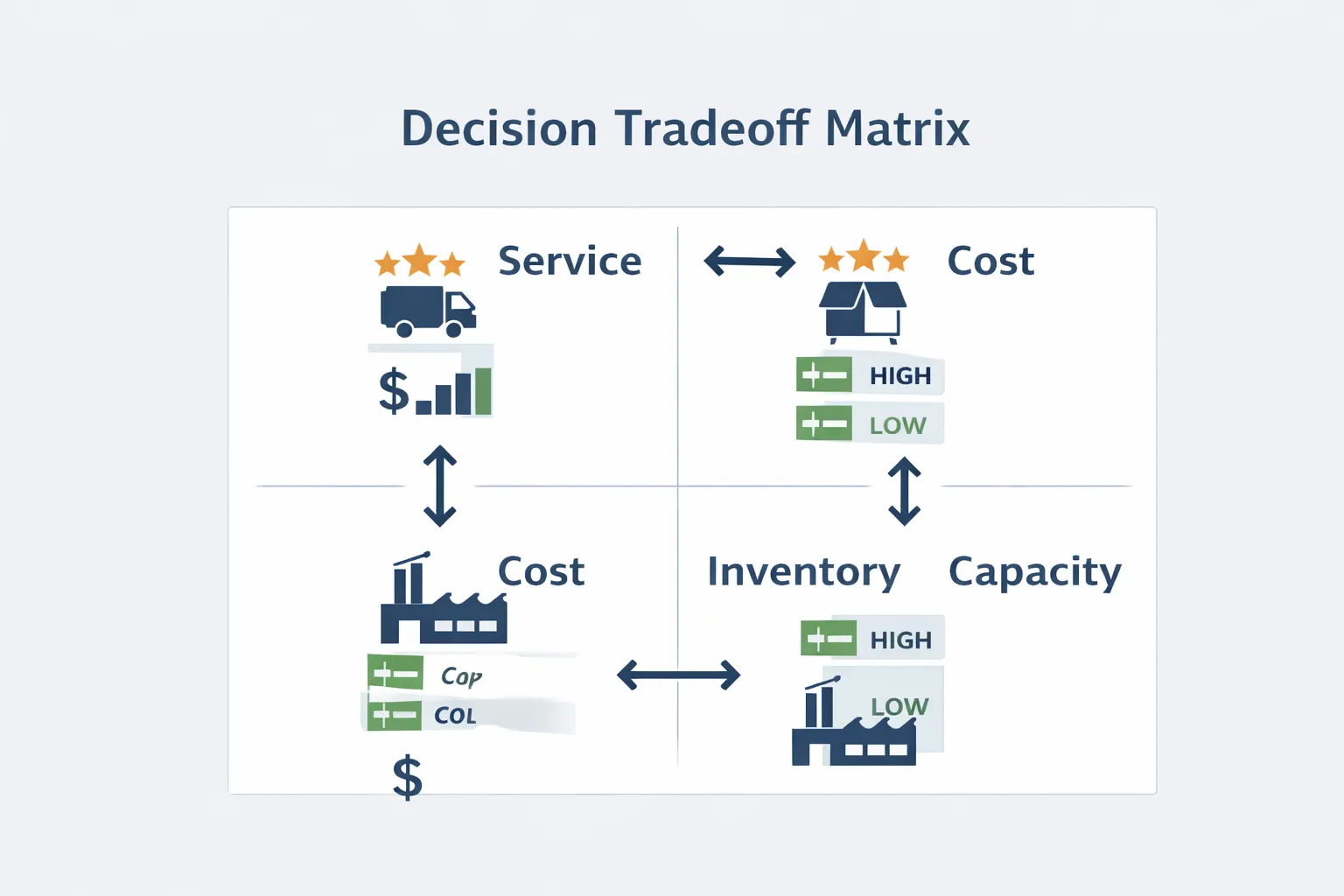
A better S&OP process helps the business:
- improve decision clarity across sales, supply chain, operations, and finance
- align tradeoffs earlier
- improve inventory discipline
- support more realistic service, cost, and capacity decisions
- reduce decision latency during disruption or change
The 5 Core Goals of an Effective S&OP Process
1. Align Demand and Supply
The first goal is to bring commercial expectations and operational reality into the same conversation. That means comparing demand plans with supply capability, inventory positions, capacity constraints, and service implications. This demand-supply balancing role is central across the benchmark sources.
2. Surface Tradeoffs Early
A good process does not hide tension. It exposes it. Whether the issue is constrained supply, a promotion spike, a new product launch, or margin pressure, S&OP should surface the tradeoffs early enough for leaders to act.
3. Connect Operations to Financial Impact
S&OP becomes much stronger when finance is not treated as a downstream reviewer. Financial implications need to be visible during the planning cycle, not after decisions are already leaning in one direction. Oracle, SAP, and Anaplan all explicitly connect S&OP to financial integration or broader business planning.
4. Improve Cross-Functional Accountability
Each function should understand both its role and the consequences of its assumptions. That is how S&OP moves from departmental planning to coordinated business planning.
5. Support Faster, Better Executive Decisions
The end point is not a slide deck. It is a better business decision. S&OP should reduce decision latency, clarify options, and help executives approve a plan the business can actually support. Oracle and Anaplan both frame S&OP as an executive decision process, not just a reporting cycle.
Sales and Operations Planning Process Steps
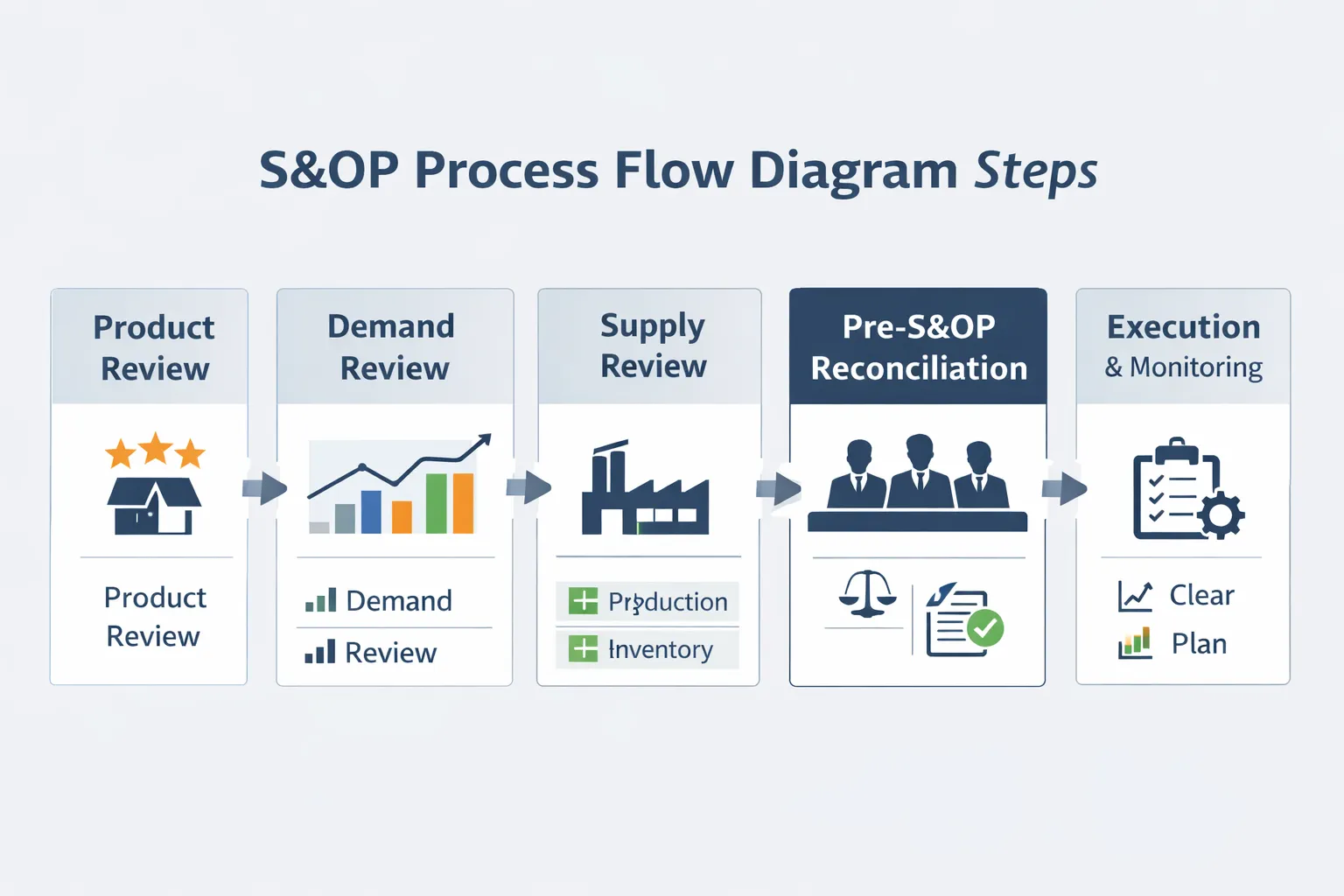
Below is a practical six-step structure for the sales and operations planning process. Anaplan outlines a six-step model, while other benchmark sources group similar activities into slightly different stages.
1. Product and Portfolio Review
This stage looks at what is entering, changing, or leaving the portfolio. New product introductions, product phase-outs, mix changes, and market shifts all affect downstream demand, supply, and resource planning. Anaplan includes product review as an early planning phase for that reason.
Typical participants: product, marketing, commercial leads, planning
Key output: portfolio assumptions that feed the rest of the cycle
Common failure mode: product changes are not reflected early enough in demand or supply plans
2. Demand Review
Here the business builds a demand view based on forecast, commercial activity, promotions, market signals, and customer expectations. The goal is not optimism. It is a demand plan that is realistic enough to be useful. Kinaxis and Anaplan both position demand planning as a core step in the cycle.
Typical participants: sales, marketing, demand planning, commercial leadership
Key output: consensus demand plan
Common failure mode: sales targets are treated as demand facts
3. Supply Review
The supply review tests the demand plan against production, sourcing, logistics, labor, and capacity realities. It should make constraints visible and produce alternatives, not just one strained answer. Anaplan notes that supply plans should balance service, inventory, and cost while considering alternate plans.
Typical participants: supply planning, operations, procurement, manufacturing, logistics
Key output: feasible supply scenarios and constraint view
Common failure mode: the team presents a single plan with hidden assumptions
4. Pre-S&OP Reconciliation
This is where the business compares demand, supply, inventory, and finance views, identifies disconnects, and frames the decisions that need escalation. This determines whether the executive meeting becomes a decision forum or just a review session. Anaplan’s pre-S&OP phase explicitly centers on gaps, disconnects, and recommendations.
Typical participants: cross-functional planning leads plus finance
Key output: recommended scenarios, tradeoffs, and escalation points
Common failure mode: too much data, not enough issue framing
5. Executive S&OP Review
This is the point where leadership reviews the options, tests the tradeoffs, and makes decisions. Executive participation matters because unresolved tradeoffs usually involve competing priorities across service, cost, capacity, revenue, and cash. Oracle and Anaplan frame S&OP as a leadership decision process.
Typical participants: executive sponsor, finance leader, functional heads
Key output: approved plan, decision log, actions
Common failure mode: meeting time is spent reviewing history rather than deciding
6. Post-Meeting Execution and Monitoring
Once decisions are made, they need to flow into execution, monitoring, and follow-up. A decision only creates value if it changes actions, priorities, and controls. Oracle ties S&OP to execution and monitoring, not just planning consensus.
Typical participants: planning, operations, commercial teams, finance
Key output: translated actions, tracked decisions, monitored performance
Common failure mode: no clear follow-through or ownership
What Good Looks Like
A good S&OP process:
- uses one shared operating view
- makes tradeoffs visible
- brings finance in early
- helps executives decide, not just review
- connects planning decisions to business impact
Who Should Be Involved in S&OP?
A strong S&OP process needs the right people in the room and the right discipline outside the room. The core group usually includes sales, marketing, supply chain, operations, procurement, inventory or distribution leads, finance, and an executive sponsor. Oracle, Kinaxis, and Anaplan all describe S&OP as a cross-functional process involving finance alongside commercial and operational teams.
That matters because each function sees only part of the problem:
- Sales sees demand opportunity
- Operations sees capacity and execution risk
- Supply chain sees inventory, lead times, and flow constraints
- Finance sees cash, cost, and profitability implications
- Executive leadership sees business priorities and tradeoff thresholds
When one of those seats is weak or missing, the process degrades. Anaplan explicitly argues that missing functional participation weakens business performance and customer outcomes.
Where the Sales and Operations Planning Process Usually Breaks Down
Many S&OP processes are not failing because the concept is flawed. They are failing because the execution is too slow, too fragmented, or too disconnected from how the business really runs.
A common breakdown is siloed preparation. Different teams bring different assumptions, different spreadsheets, and different definitions of success. Commercial teams push for volume. Operations protects feasibility. Finance reviews late. Nobody is wrong, but the business still ends up misaligned.
Another breakdown is stale information. Kinaxis points out that traditional S&OP cycles have often relied on siloed tools such as spreadsheets and emails, creating slower and less connected planning. Oracle highlights the difficulty of turning large, diverse data sets into useful decision support.
A third breakdown is weak decision design. Teams spend too much time preparing reports and not enough time clarifying the choices. The executive session becomes a performance update instead of a decision forum. At that point, the process may still look active, but it is no longer doing its real job.
Common Failure Points
- siloed data and assumptions
- spreadsheet-heavy reconciliation
- finance involved too late
- too much reporting, not enough issue framing
- unclear decision rights
- executive review focused on updates instead of tradeoffs
- a monthly cycle that is too slow for actual operating conditions
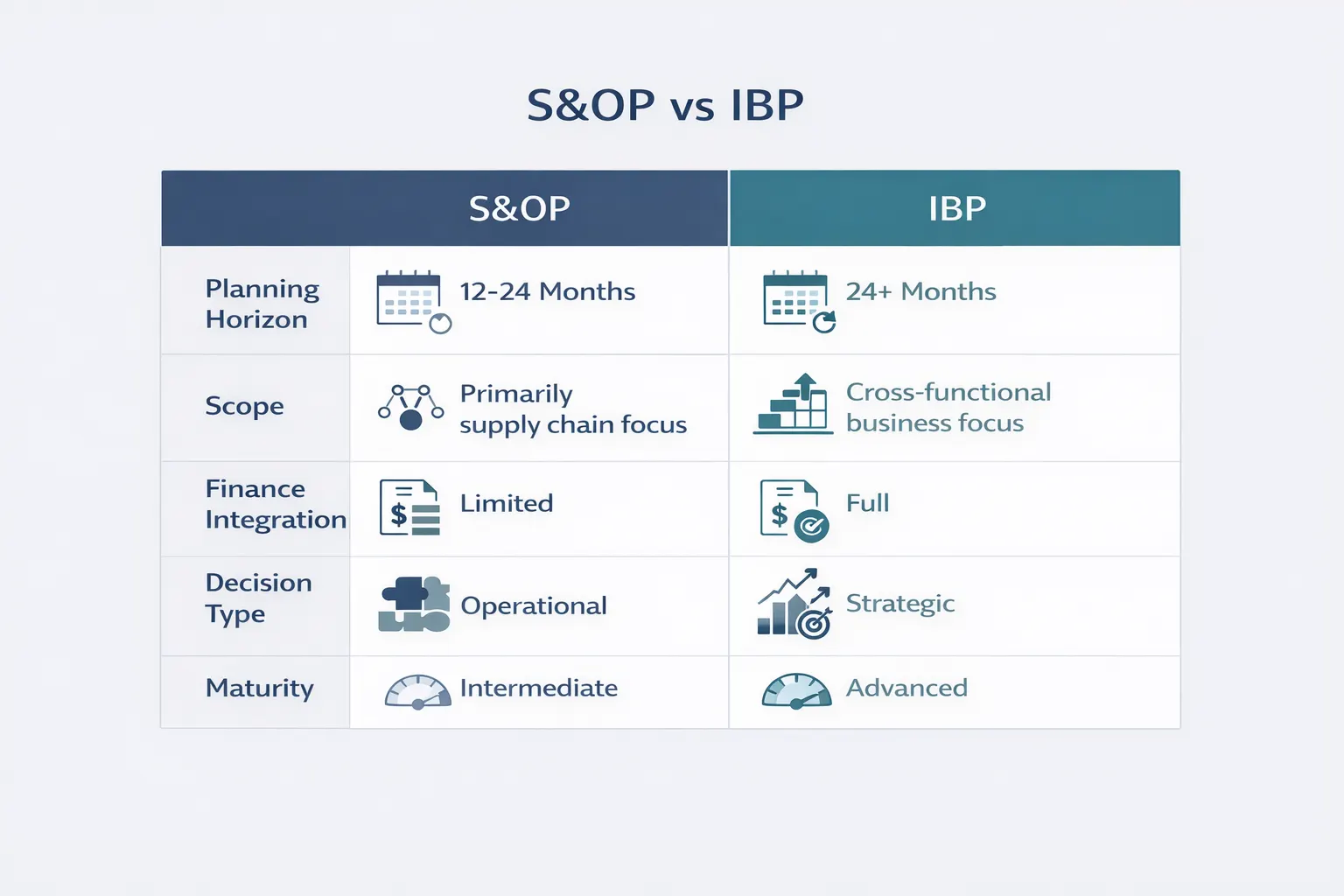
S&OP vs IBP: What Is the Difference?
S&OP and IBP are related, but they are not identical. In simple terms, S&OP is the core cross-functional process used to balance demand, supply, inventory, capacity, and near- to mid-term business priorities. IBP, or integrated business planning, is broader. It typically extends planning further across the business and places even more weight on strategic and financial integration. Oracle and SAP describe IBP as broader and more integrated than traditional S&OP.
For many organizations, the right move is not to rename a weak S&OP process as IBP. It is to strengthen S&OP first. If the current process still struggles with shared numbers, cross-functional alignment, executive decisions, and finance integration, then the maturity problem is not branding. It is process quality.
A useful way to think about it is this:
- S&OP helps the business make coordinated operational and tactical decisions
- IBP extends that discipline into broader strategic and financial integration
Done well, S&OP is often the foundation that makes stronger IBP possible.
What Metrics Should You Track in the Sales and Operations Planning Process?
If you only track whether the meeting happened, you are not tracking S&OP. The best metrics show whether the process is improving decision quality and business performance.
Decision Quality and Alignment
- forecast accuracy
- forecast bias
- decision cycle time
- issue escalation resolution time
- plan adherence
Inventory and Working Capital
- inventory turns
- days of inventory on hand
- excess and obsolete inventory
- stock exposure by segment
- working capital tied up in inventory
Service and Operations
- fill rate or OTIF
- backlog risk
- schedule stability
- capacity utilization
- service impact of constraints
Financial Outcomes
- margin impact
- revenue at risk
- cost-to-serve impact
- budget variance
- cash impact of inventory or supply decisions
The benchmark pages connect S&OP to forecast quality, service levels, working capital, profitability, and broader business performance. This article pushes that one step further by treating those outcomes as indicators of decision quality, not just planning output.
What a Modern S&OP Process Should Look Like
A modern S&OP process should be connected, issue-led, and business-aligned.
Connected means teams are not reconciling multiple versions of the truth at the last minute. Issue-led means the process brings forward the most important tradeoffs and exceptions instead of burying them in slide volume. Business-aligned means finance, service, cost, inventory, and strategic priorities are visible together.
Oracle highlights more continuous planning, improved responsiveness, and stronger use of AI and execution data. Kinaxis emphasizes faster planning, concurrent visibility, and moving beyond slow, rigid cycles. Anaplan stresses connected plans, shared dashboards, and executive decision-making grounded in cross-functional information.
In practice, that means a modern process should:
- show the business where the real tradeoffs are
- reduce manual reconciliation
- make assumptions easier to compare
- connect operational choices to financial consequences
- support more timely action when conditions change
That is what modern S&OP should improve: not just plan quality, but decision quality.
How AI Can Improve the Sales and Operations Planning Process
AI can make the sales and operations planning process more useful, but only if it improves decision support in business reality.
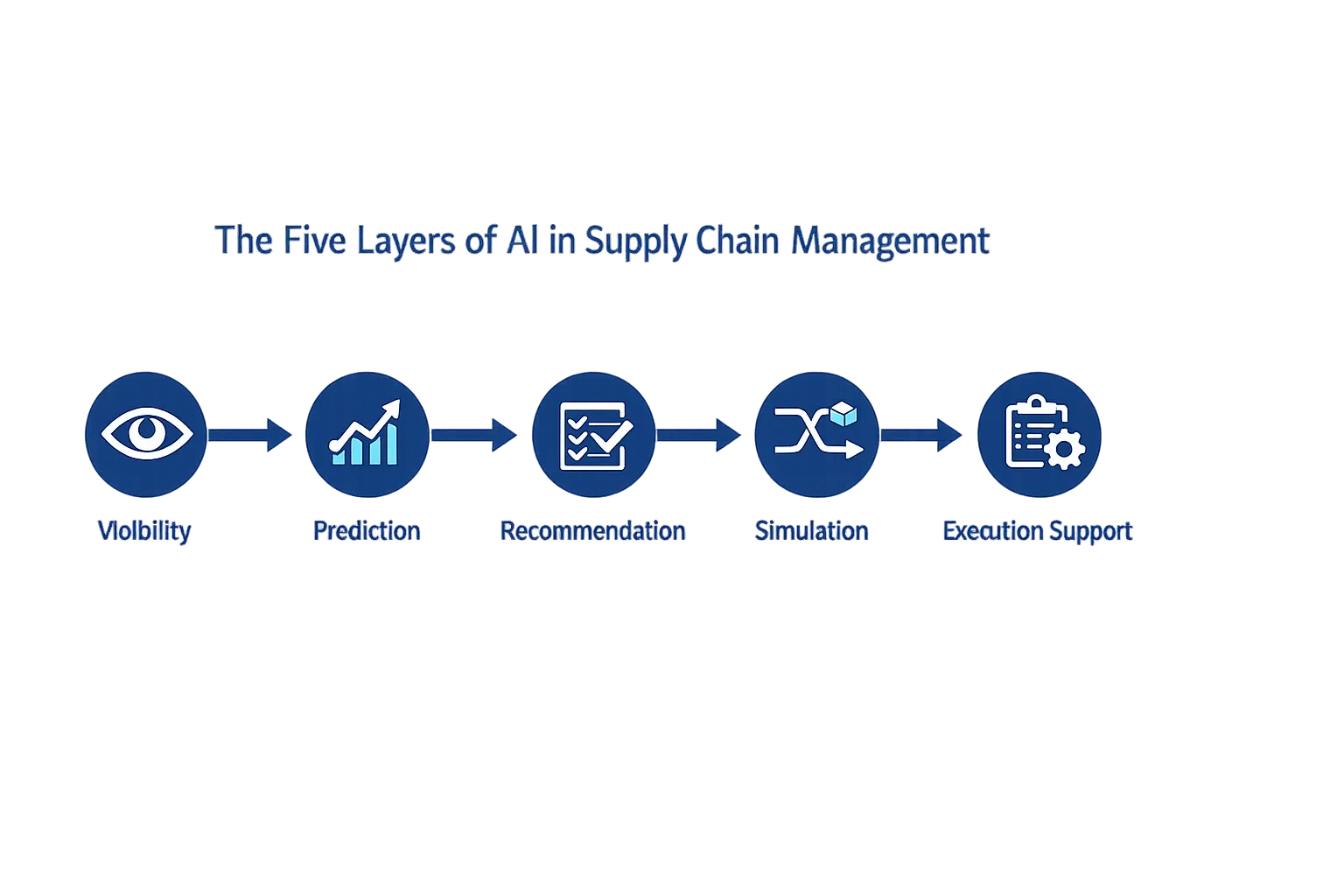
Used well, AI can help detect forecast shifts earlier, highlight exceptions faster, compare scenarios, surface likely constraints, and reduce the time spent preparing pre-reads. Oracle discusses AI-supported planning in S&OP, and Anaplan emphasizes scenario review and data-driven decisions.
What AI should not do is create a false sense of confidence. S&OP still requires judgment, cross-functional context, and clear business rules. The goal is not autonomous planning theatre. The goal is better visibility, tighter controls, and faster, more financially grounded decisions.
In that sense, the best use of AI in S&OP is narrow and practical:
- flag what changed
- compare the options
- show likely business impact
- help the team focus on the decisions that matter most
Signs Your S&OP Process Needs Work
Your S&OP process likely needs attention if any of the following are true:
- the meeting produces updates but not decisions
- different functions show up with different numbers
- finance is informed late instead of shaping tradeoffs early
- inventory keeps rising without a corresponding service improvement
- service issues keep recurring even though the business reviews plans every month
- executive decisions are revisited because the original tradeoffs were not clear
- teams spend more time building decks than resolving issues
- disruptions trigger repeated firefighting outside the process
These symptoms align closely with the failure patterns described across the benchmark material: weak alignment, slower cycles, stale assumptions, poor integration, and insufficient executive decision discipline.
How to Improve Your Sales and Operations Planning Process
Improving S&OP usually starts with discipline, not software.
First, define the decisions the process is actually supposed to support. If the team cannot clearly state the recurring decisions, the process will drift into reporting.
Second, tighten cross-functional ownership. Every major assumption should have an owner, and every major tradeoff should have a clear path to decision.
Third, connect finance earlier. If working capital, cost, margin, and service implications are only discussed at the end, the process is missing one of its most important control functions. Oracle, Kinaxis, and Anaplan all make finance participation central to effective S&OP.
Fourth, reduce spreadsheet dependency where it is slowing visibility or creating reconciliation drag. That does not mean chasing technology for its own sake. It means removing friction that weakens decision quality.
Fifth, use scenarios deliberately. A good S&OP process should show leaders the implications of a small set of real options, not force debate around one assumed plan.
Finally, track whether the process is reducing decision latency and improving alignment. That is often the clearest early sign that the process is becoming more useful.
See Where Your S&OP Process Is Slowing Decisions or Weakening Alignment
If your sales and operations planning process feels heavy, slow, or disconnected from finance and execution, the issue is rarely just cadence. More often, it is a visibility, control, and decision-support problem.
Frequently Asked Questions About the Sales and Operations Planning Process
What is the sales and operations planning process?
The sales and operations planning process is a recurring cross-functional process used to align demand, supply, inventory, capacity, and financial goals so the business can make better decisions. Oracle, Kinaxis, Anaplan, and SAP all describe S&OP as a structured process connecting operational planning with broader business outcomes.
What are the steps in the sales and operations planning process?
A practical S&OP cycle often includes six steps: product and portfolio review, demand review, supply review, pre-S&OP reconciliation, executive review, and post-meeting execution and monitoring. Different providers group the steps slightly differently, but these activities are commonly present.
Who should be involved in sales and operations planning?
S&OP should involve sales, marketing, supply chain, operations, finance, and executive leadership. Procurement, manufacturing, and inventory or distribution leaders may also be involved depending on the business.
What is the difference between S&OP and IBP?
S&OP focuses on cross-functional operational and tactical alignment. IBP is broader and usually includes stronger strategic and financial integration across the business. Oracle and SAP both position IBP as broader than traditional S&OP.
How often should the S&OP process run?
Most organizations run S&OP on a monthly cadence, though stronger processes may use more frequent exception reviews or additional planning checkpoints when conditions change quickly. The benchmark sources commonly describe S&OP as a regular recurring cycle, often monthly.
What metrics should be tracked in S&OP?
Good S&OP metrics include forecast accuracy, decision cycle time, plan adherence, inventory turns, service levels, working capital exposure, and financial impact indicators such as margin or revenue risk. These align with the outcome areas emphasized across the benchmark sources.
How can AI improve the sales and operations planning process?
AI can improve S&OP by highlighting exceptions, supporting scenario comparison, spotting forecast or supply shifts earlier, and helping teams focus on the most important tradeoffs. Oracle in particular highlights AI-supported planning capabilities in modern S&OP.
Why do S&OP processes fail?
S&OP processes usually fail because of siloed data, slow manual reconciliation, weak finance integration, unclear decision rights, and executive reviews that focus on updates instead of actual decisions. Those issues are echoed across the benchmark material.