Decision Clarity in Supply Chain Management: Why Better Structure Leads to Better Outcomes
Decision Clarity in Supply Chain Management: Why Better Structure Leads to Better Outcomes
Apr 22, 2026
by: Corey Weekes
Supply chain leaders are under pressure to move faster.
Demand shifts faster. Policy risk moves faster. Internal expectations move faster. Technology conversations move faster than almost everything else.
That pressure is real.
But speed on its own is not the goal. Speed without clarity creates cost, misalignment, and unnecessary risk. It creates more meetings, more exceptions, more overrides, and more debate about what should have happened after the fact.
That is why decision clarity matters.
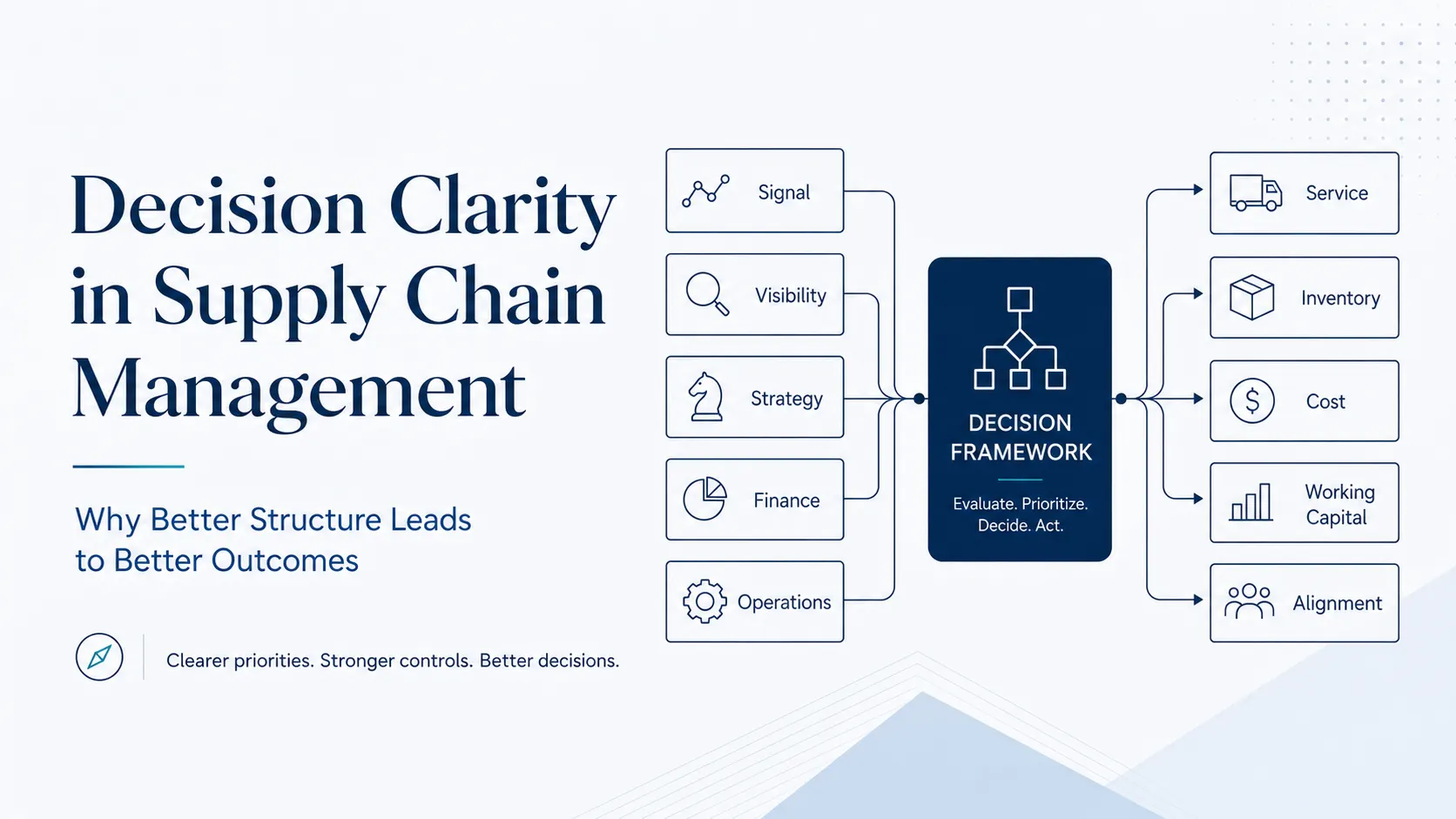
Many organizations do not have a dashboard problem first. They do not even have a technology problem first. They have a decision problem first. They have information, but not enough agreement on what matters most. They have reports, but not enough shared logic for acting on them. They have activity, but not enough structure connecting supply chain actions to service, cost, inventory, working capital, and business performance.
Decision clarity is what closes that gap.
What decision clarity in supply chain management actually means
Decision clarity in supply chain management is the ability to make decisions that are timely, consistent, cross-functionally aligned, and grounded in business priorities.
It is not just visibility.
It is not just analytics.
It is not just speed.
It is not just “better collaboration.”
Decision clarity means the business is clear on five things:
- which decisions matter most
- who owns those decisions
- what trade-offs govern them
- what operational and financial consequences follow from each option
- what should happen when conditions change
In practice, decision clarity sits where strategy, finance, operations, and execution meet. It turns information into action. It makes trade-offs visible before they become expensive. It allows an organization to move faster without becoming more chaotic.
Why supply chain decisions still break down
Most supply chain decisions do not break down because people do not care. They break down because the system around the people is unclear.
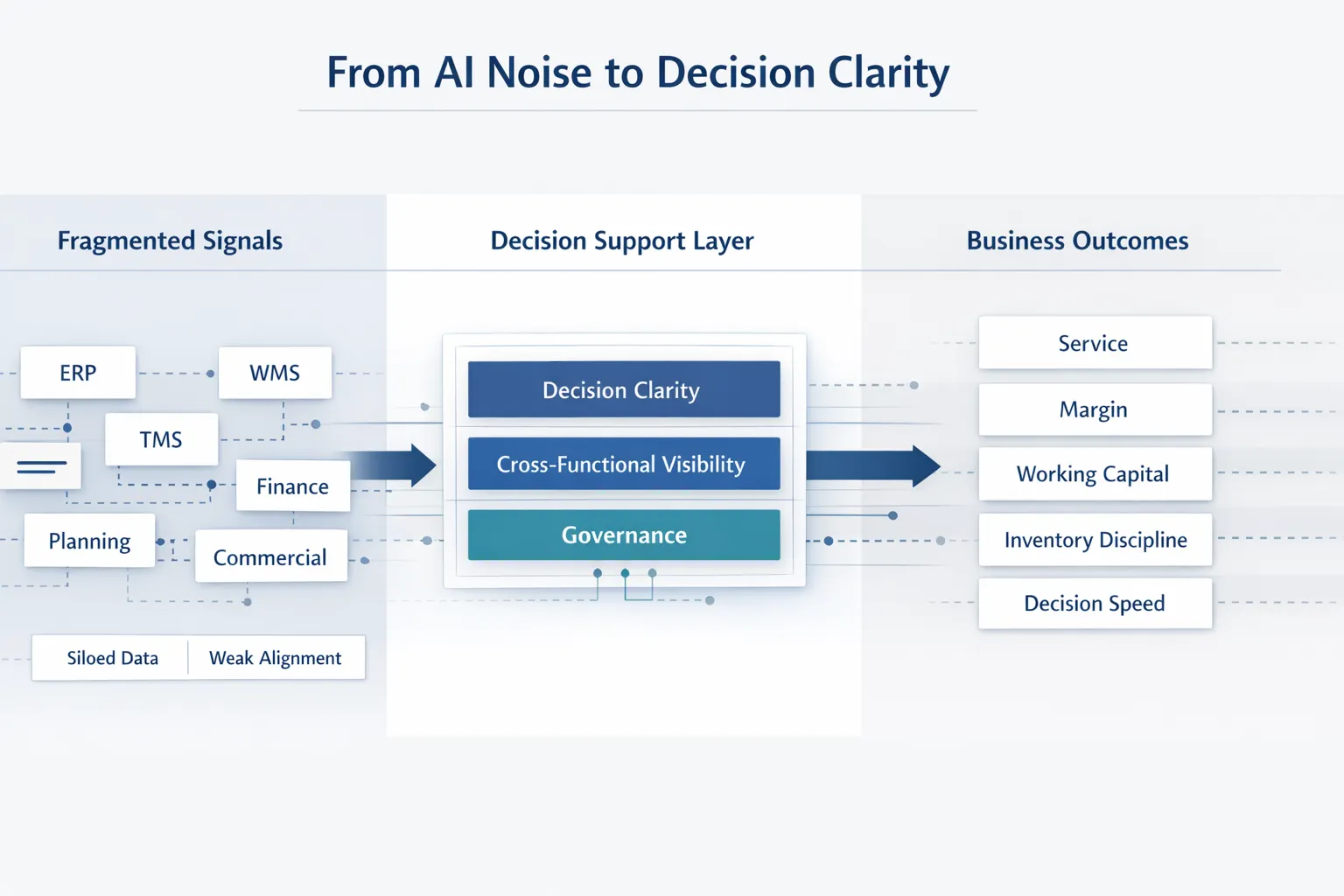
One common problem is too much noise and not enough signal. Leaders are dealing with volatility, policy shifts, demand swings, supply disruption, margin pressure, and constant technology chatter. The result is often reactive decision-making. Teams spend more time debating than deciding. Energy gets pulled toward the loudest issue in the room rather than the issue that matters most to the business.
Another problem is visibility without decision logic. Many organizations have invested heavily in dashboards, alerts, scorecards, and control-tower language. Yet visibility alone does not create clarity. If there is no agreed logic for acting on what people see, then better visibility simply gives everyone a better view of the confusion.
A third problem is functional thinking disguised as alignment. Supply chain, finance, commercial, and operations teams often work hard, but not from the same scoreboard. One function pushes service. Another protects margin. Another focuses on inventory. Another prioritizes local efficiency. When that happens, decisions may look reasonable in isolation while still damaging overall business performance.
A fourth problem is decision latency. Some businesses still spend too much energy defending planning cadence and not enough energy improving decision cadence. They are better at discussing volatility than responding to it. By the time a decision is agreed, the condition that triggered it may already have changed.
Why decision clarity matters more now
Decision clarity has always mattered. It matters more now because operating conditions have made hesitation, contradiction, and fragmented ownership more expensive.
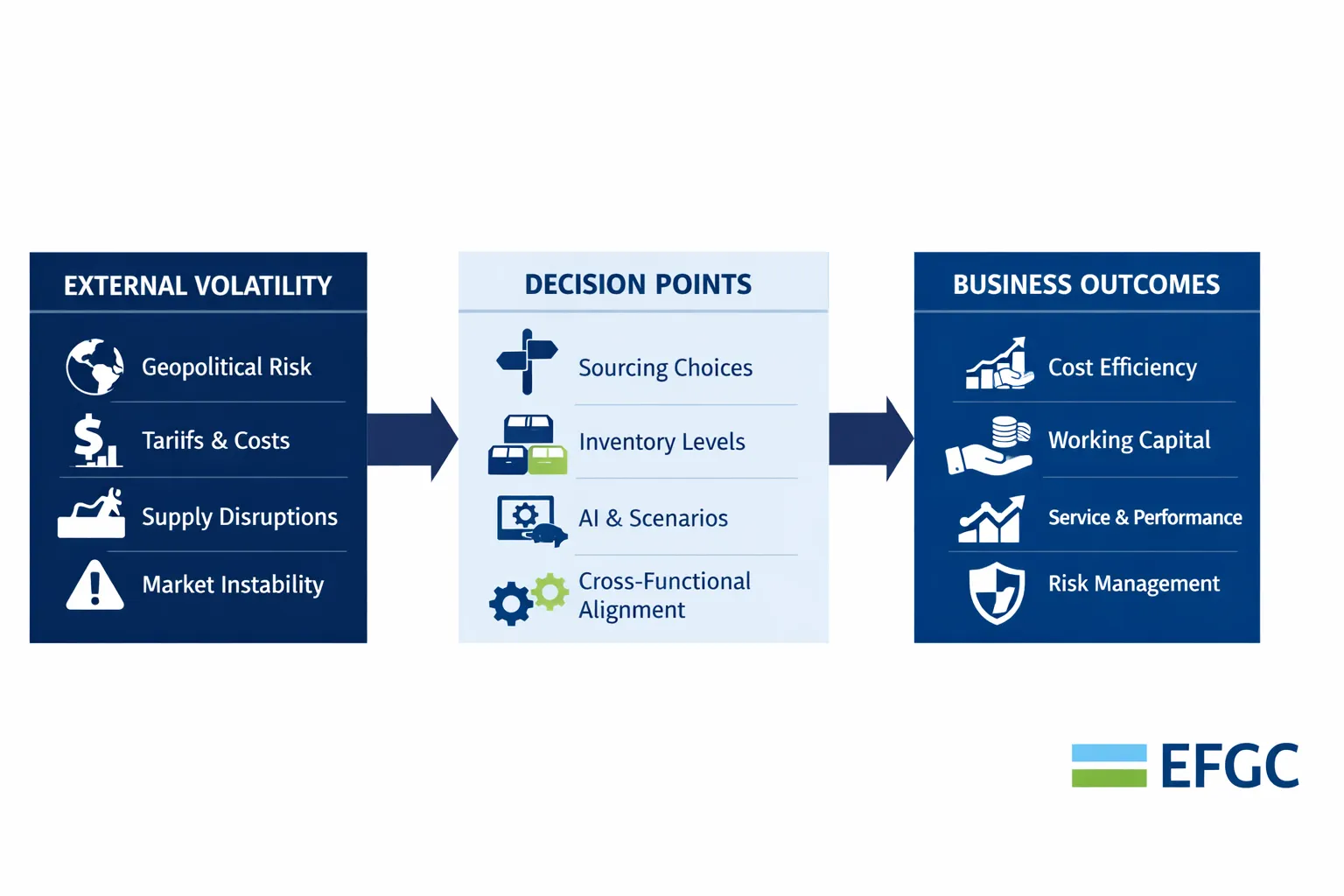
Supply chain leaders are being asked to protect service, manage cost, improve cash discipline, respond to sourcing shifts, absorb disruption, and explore AI at the same time. That combination creates pressure to move fast.
But moving fast is not the same as moving well.
Without decision clarity, teams burn working capital in the wrong places. They expedite where earlier policy could have prevented the problem. They chase service in ways that damage margin. They launch projects that improve reporting more than outcomes. They confuse motion with progress.
With decision clarity, the business can decide faster and with more consistency under real constraints.
That is the difference.
The business impact of better decision clarity
Decision clarity is not a soft concept. It changes hard outcomes.
It improves service because teams make fewer contradictory calls about allocation, replenishment, and customer priority.
It improves inventory discipline because the business becomes clearer on what inventory is for, where it belongs, and what trade-offs are acceptable.
It reduces decision latency because leaders stop re-litigating the same questions in different meetings with different data.
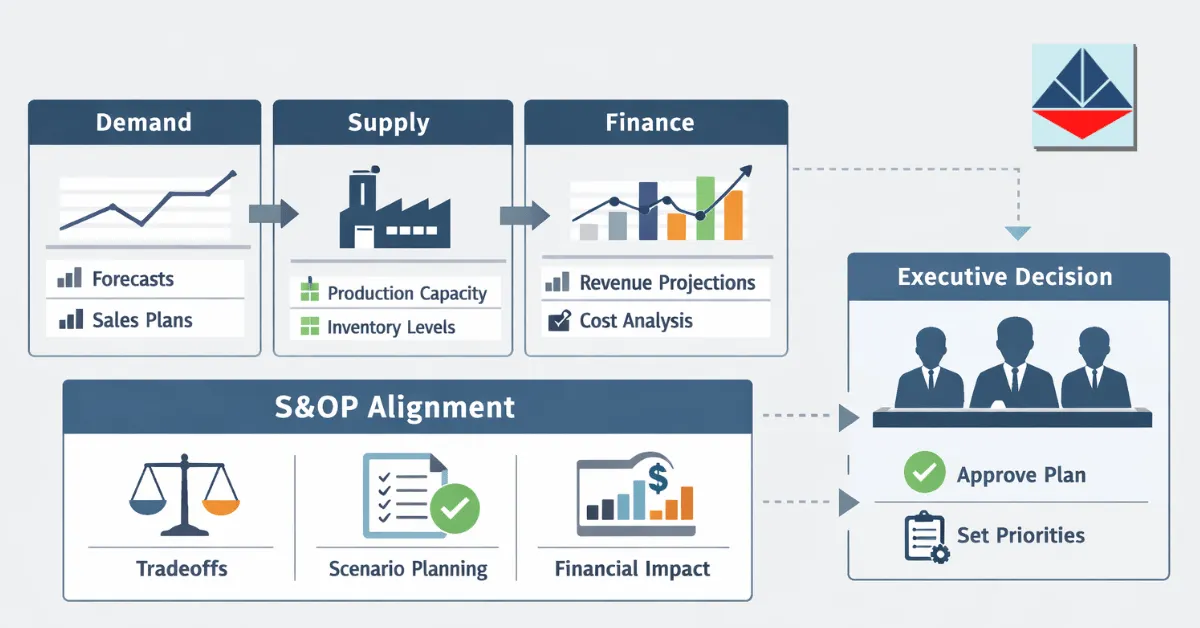
It improves cross-functional alignment because operations, finance, and commercial teams begin to work from a shared decision framework rather than a collection of siloed measures.
It improves business performance because it makes the service-cost-cash relationship explicit.
That matters. Supply chain decisions do not only affect operations. They affect revenue reliability, inventory exposure, margin protection, working capital, and the quality of strategic execution. Better decisions improve outcomes because they make trade-offs visible before those trade-offs turn into cost.
What creates decision clarity in practice
Decision clarity does not appear because people ask for it nicely. It has to be built.
The first requirement is strategic clarity before technology. Before any system, model, or AI tool is evaluated, the business needs to be clear on how it intends to compete. Is the priority cost leadership, differentiated service, speed, product leadership, margin protection, or some other deliberate position? If that is unclear, technology tends to automate confusion rather than reduce it.
The second requirement is quantified trade-off logic. Strategy needs to be translated into measurable targets and decision guardrails. That includes priorities around service, margin, inventory, cash, lead-time risk, and customer importance. If teams do not understand the trade-offs they are meant to manage, they will default to local judgment, local pressure, or local politics.
The third requirement is a small set of decision rules. Businesses often suffer because they rely on endless case-by-case debate for decisions that should already be structured. Clear decision rules reduce wasted energy. They help teams act with more consistency under pressure.
The fourth requirement is cross-functional context. Supply chain decisions are rarely driven by one table, one dashboard, or one function. They sit inside a web of relationships: customers, products, suppliers, inventory positions, transport realities, service commitments, and financial consequences. Decision clarity improves when that context is visible and shared.
The fifth requirement is sequencing. Many organizations try to improve too many things at once. That creates a backlog of disconnected initiatives rather than a clear path forward. Better results usually come from choosing the few levers that matter most, fixing the constraints that block performance, standardizing decision logic, and then applying automation or AI where it can genuinely strengthen execution.
The sixth requirement is clear ownership across silos. Cross-functional decisions often fail because no one truly owns them end to end. Someone has to connect business priorities, process logic, operational reality, and follow-through. Without that ownership, issues fall between functions and remain unresolved until they become more expensive.
Why AI should support decision clarity, not replace it
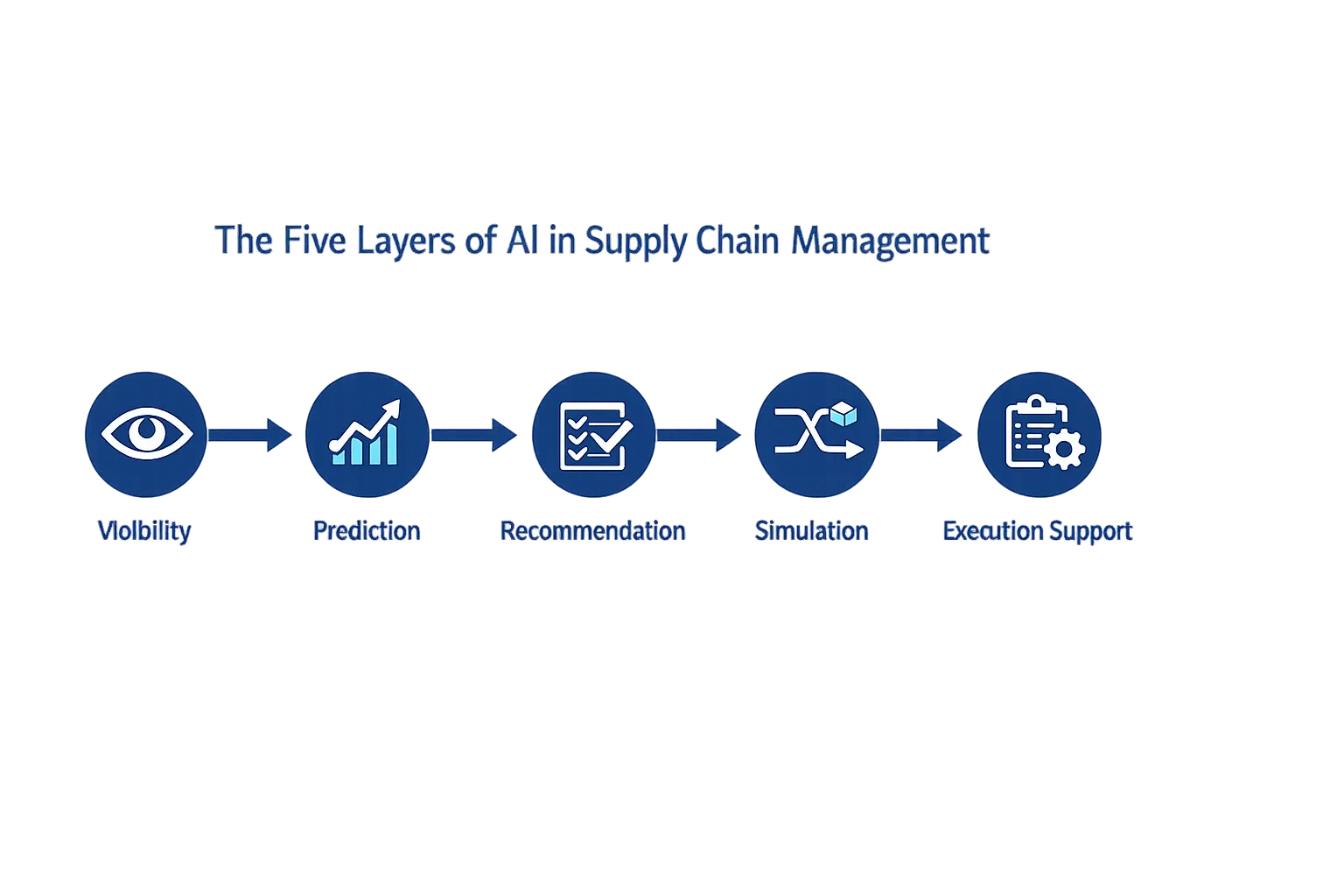
AI has an important role to play in supply chain management. It can help organizations detect changes faster, compare scenarios more quickly, surface the exceptions that matter most, and apply decision logic more consistently.
But AI does not create decision clarity on its own.
If the business has not defined the decision, the owner, the guardrails, the context, and the expected outcome, AI will not fix that. In many cases, it will simply multiply the noise.
The right use of AI is practical. It should sharpen judgment, reduce decision latency, and support more consistent action. It should compress the path from signal to decision, not create more analysis disconnected from action.
The key question is not “Where can we use AI?”
The better question is “Which decisions would improve if AI helped us see, compare, and act more clearly?”
That is where value begins.
A practical framework for improving decision clarity
A simple way to assess decision clarity is to work through four questions.
1. What is the decision?
Be specific. Not “improve planning.” Not “improve service.” Which exact decision is being made? Allocation. Replenishment. Expedite versus miss. Substitute versus backorder. Which customer gets limited inventory? Which signal triggers escalation?
2. What business logic governs it?
What are the priorities, thresholds, and trade-offs? Which customers matter most? What margin floor is acceptable? How much lead-time risk is tolerable? When should cash be protected and when should service win?
3. What cross-functional inputs are required?
Which demand signals, inventory realities, supplier constraints, commercial priorities, transport conditions, and financial considerations need to be visible?
4. What outcome is expected?
How will the business know the decision improved performance? Better service on the right accounts. Lower expedite spend. Improved inventory velocity. Better margin protection. Reduced decision latency. Stronger working capital performance.
If the business cannot answer those four questions clearly, it does not yet have decision clarity. It has a decision event, but not a decision system.
Common signs your organization has a decision clarity problem
The symptoms are usually visible long before leaders name the issue directly.
You may have a decision clarity problem if:
- the same trade-offs get debated repeatedly
- the business has lots of reporting, but low confidence
- different functions tell different stories about the same issue
- projects are justified in technology language more than business language
- inventory rises while service still disappoints
- expedites and overrides become normal operating practice
- meetings produce discussion, but not action
- AI pilots generate interesting outputs, but little change in outcomes
- finance and supply chain do not share the same scoreboard
When several of these signs are present, the issue is rarely a lack of effort. It is usually a lack of structure.
Decision clarity is a leadership discipline
Decision clarity is not only a supply chain capability. It is a leadership discipline.
Enterprise supply chain leaders care about visibility, control, decision speed, execution alignment, and inventory discipline. Finance leaders care about cost, working capital, and financially grounded decisions. Commercial leaders care about revenue reliability and customer outcomes. Operations leaders care about what can actually be executed.
Decision clarity matters because it improves all of those things.
That is why it cannot sit only inside the planning function. It needs leadership sponsorship across the business. It needs commercial input because customer promises shape the trade-off. It needs finance input because capital and profitability shape the trade-off. It needs operations input because physical reality shapes the trade-off. And it needs clear governance because unclear trade-offs tend to survive when no one is willing to force the issue.
Final takeaway
Better supply chain performance does not begin with more dashboards.
It does not begin with more alerts.
It does not begin with more meetings.
And it does not begin with AI for its own sake.
It begins with better structure.
Clearer priorities. Clearer decision rules. Clearer ownership. Clearer context. Clearer links to service, cost, inventory, cash, and business performance.
That is what decision clarity in supply chain management really means.
It is not a slogan. It is not a soft skill. It is a practical operating advantage.
The organizations that perform best are rarely the ones with the most activity. They are the ones with the clearest decisions.
If your organization has visibility but still struggles with slow, fragmented, or low-confidence decisions, take the Diagnostic to identify where decision clarity is breaking down across strategy, operations, and finance.