
SIDS Post-Covid Policy Success: Leveraging Supply Chain Strategy
SIDS Post-Covid Policy Success: Leveraging Supply Chain Strategy
Aug 18, 2021
A Barbados Case Study
by: Corey Weekes
Current SIDS Realities and Macro Solution Requirements
Small Island Developing States (SIDS) are vulnerable to external financial and economic shocks relative to industrial economies. This is especially true for the islands of the Caribbean.

These vulnerabilities center around an over-reliance on a single industry to finance their economies. This single industry usually falls in one of the following categories:
- An extractive natural resource,
- A commodity crop,
- A service-based industry, like tourism.
Added to this vulnerability, many small-island developing states run large current account deficits, which further hinders their economic stability.
These vulnerabilities were present before the global impact of COVID-19 (COVID). But with so many economies dependent on tourism, the situation is now exacerbated.
Most tourism-dependent economies have seen visitor-level drops ranging from 50-70%. And corollary tourism foreign exchange receipts decline. With the emerging COVID variants, it’s hard to predict when, or if, visitor levels and foreign exchange receipts will return to pre-COVID levels.

The overwhelming rallying call now is to diversify economically. But, this is not easy. Large current account deficits and reduced foreign exchange inflows lead to the lack of room for SIDS governments to invest. So, even though economic diversification is compulsory, finding effective diversification paths is challenging.
In this article, we explore and present a very viable approach to such success.
It leverages 4 key Supply Chain Management principles that underpin successful global organizations today. SIDS, who ground their post-COVID industrial policy and execute on these principles, would not only attract successful organizations, but build successful diversification industries.
4 Supply Chain Elements Critical for Industrial Policy Success
In order for organizations to build successful, profitable supply chains, 4 elements MUST be in place. And, operational analysis on any successful industrial organization will show they are winning against their peers in these 4 areas:
- Effective sourcing and cost-efficient multi-mode routing to the organization
- Efficient input conversion to finished product
- Easy, quick multi-mode customer market reach
- Competitive market pricing that allows for items 1, 2, and 3 to be in the goldilocks percentage of revenue zone
The industrial policy will never be successful, if it offers a prospective organization one or two of the mentioned elements only. The policy has to offer end-to-end supply chain success in ALL elements. This cumulative effect results in profitability for the organization if located in a SIDS jurisdiction.
The SIDS island can then use these criteria to vet and target organizations, and execute a viable post-COVID diversification policy.
Unfortunately, many SIDS try to attract any organization they can. A scatter shot approach. Without specific analysis or understanding of how their jurisdiction impacts the 4 elements of a company’s end-to-end supply chain. Some companies may be attracted initially, but their operations will not endure, and industries would not be built.
The industrial diversification approach should be reversed. Solve for these 4 elements first. Then target and attract the organizations where the 4 supply chain elements align.
KEY TAKEAWAY: Successful industries can only be built when successful end-to-end supply chains or value chains are in place.
Effective sourcing & cost-efficient multi-mode routing to the organization

The first key element for an organization’s long-term supply chain success, is the ability to effectively source input materials. This should be from a broad market base for maximum competitiveness. Even more important, is the ability to get the input materials to the company cost-effectively. This can be through various modes of transport choices e.g ocean shipping or air freight.
In a post-COVID environment, ocean freight pricing and transit time variability have increased dramatically. This trend will continue for several years. Organizations must have the flexibility to switch modes, for at least part of the supply requirements, to support production operations. Companies restricted to using ocean freight because of the size, shape, density, and transport costs, would not be good target candidates for SIDS industrial policy.
Ocean route coverage, vessel capacities, and voyage frequencies are not favorable, when compared to traditional developed country locations. So, any organization that requires this mode of shipping for their input materials, would be at a competitive disadvantage in a SIDS jurisdiction.
Air freight and parcel carrier airlines provide much greater connectivity globally. If an organization has the ability to switch modes either fully or partially, to move their inputs from any global location cost-effectively, a SIDS location could be considered.
KEY TAKEAWAY: Policymakers should include this assessment as part of their industrial policy strategy to target organizations.
Efficient input conversion to finished product

This supply chain element is the easiest to appreciate, as all organizations strive to convert inputs into profitable sellable products, for shareholder and stakeholder benefit. It is also the area where SIDS have, and continue to offer great organizational incentives.
Some of these incentives which enhance operational profitability in a SIDS jurisdiction include:
- Favorable import duties and corporate tax rates.
- Building and infrastructure grants or low rent offers.
- Employee training grants.
These incentives are certainly beneficial and should be encouraged and expanded in a post-COVID environment.
Incentive expansion to encourage and enhance the development of ancillary service clusters via the SIDS industrial policy could be in the form of
- Easy access to remote work visas for key personnel to support the organization, on island.
- Promoting support ecosystems which foster the growth of adequate and well-trained accountants, lawyers, and other professionals.
- Educational institutions offering courses and programs that equip the labor pool with appropriate skills needed across a range of job levels.
- Industrial park zoning to ensure adequate transportation links for employees,
- Also, facilities like schools and daycare institutions are adjacently located for employee quality of life benefits.
SIDS have traditionally done well in this area of their industrial policy. It is usually the main focus in attracting organizations to their shores. This should continue. It levels the playing field when comparing a SIDS jurisdiction to other developed countries.
KEY TAKEAWAY: Continue, accelerate and expand on this approach to industrial policy execution
Easy, quick multi-mode customer market reach

The third key element needed for an organization’s long-term supply chain success, is easy, quick multi-mode customer market reach. This element has similarities to the first point - the need for cost-effective, multi-mode freight movement options. But the reason and importance of this element is different.
Organizations would cease to exist if they can’t get their products to customers. It may be the best designed and engineered item. But if customers can’t easily get the product, the organization will not be viable.
The current “internet era” has shrunk customer expectations globally. Online shopping trends have led to fast delivery expectations. Customers no longer have the appetite to wait for long delivery times. Lengthy transit times may have been suitable in traditional modes of shipping products to customers at lower economics. But today, organizations are now required to offer speedy delivery, otherwise, they will lose market share to competitors who can.
As is the case with most SIDS, organizations located in their jurisdictions are geographically far away from their customer base in developed countries. The only means of competing effectively on delivery speed and timing is to use air freight or parcel carrier services like UPS, DHL, or FedEx. These carriers have excellent global logistics networks to move freight internationally in time frames that satisfy customers. They also allow organizations to remain competitive in this element.
Targeting organizations restricted to using ocean freight (due to the size, shape, density, and transport costs of their finished goods) excludes them from being competitive across many industries today. The industrial policy therefore should be directed at organizations whose products allow for air freight or parcel carrier delivery into global markets from SIDS jurisdictions.
KEY TAKEAWAY: If you cannot consistently get your product to market in a competitive time frame, you will lose your customer base
Competitive market pricing that allows for the 3 elements to be in the goldilocks percentage of revenue zone

This is the last and most important supply chain element that must be in place, to allow for long-term operational viability.
The costs associated with the network, logistics flows, and modes, must allow for operational profitability. Supply chain costs for the previous 3 elements should have a low percentage of revenue impact. This ensures that the competitive selling price of the organization’s products supports the logistics and operations cost to operate from a SIDS location.
This is one reason why low-priced goods, manufactured in SIDS locations face difficulties in export markets. The economics to move these goods to consumer markets quickly do not work. The costs to import raw materials, manufacture, and then export, represent too large a percentage of revenue. They do not afford operational profitability. If an organization cannot generate sufficient gross margins, it would not be viable long term.
The critical policy focus therefore, is to target organizations where economics and selling price allow for operational profitability. This should be after the 3 other elements are vetted and confirmed to be in place.
KEY TAKEAWAY: One from four leaves ZERO. One or two elements working is not good enough. ALL elements have to be in place for low percentage of revenue impact for success
Why SIDS like Barbados can compete - The Lenstec Analysis
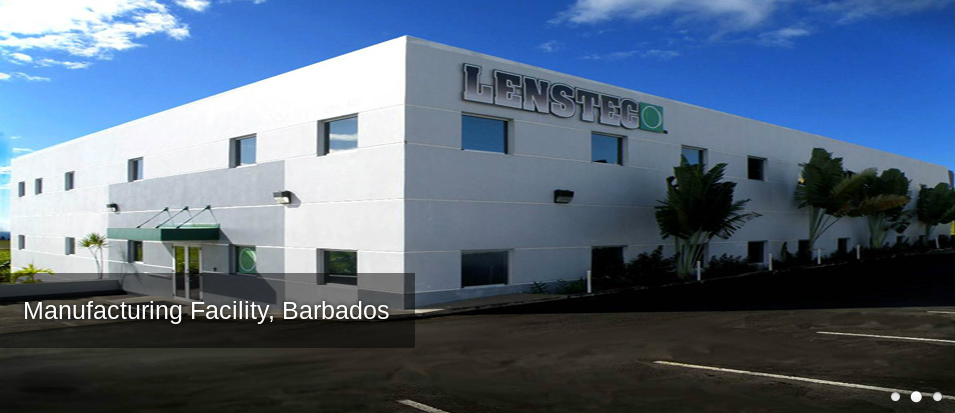
The guidance on industrial policy focus is seen in practice, when we reviewed the "surgically implanted lens" manufacturing organization, Lenstec. (Full disclosure - I am a past manager at Lenstec Barbados Inc. of several years)
This organization has been successfully operating in Barbados over the last 20 years. Their ongoing success is not a fluke but underpinned by the 4 supply chain elements outlined above.
In summary, Lenstec’s operational model is as follows.
- They import most of their raw materials and inputs via air freight.
- Producing their lenses in Barbados allows for relatively low labor costs per unit. Compare this to their competitors in more developed, higher labor costs per unit countries. Also, additional financial incentives, result in comparatively low operational costs.
- Lenstec is located next door to one of the popular global parcel carriers. This gives them the ability to use daily parcel carrier service to 180+ global countries as needed. Any global customer is within reach in a matter of days.
- The lenses are high price point items. The relative percentage of revenue costs to import via air freight and export via global parcel carrier results in operational profitability. This is key for long term viability.
KEY TAKEAWAY: The real-world example confirms where SIDS should focus their industrial policy targeting efforts. It's not the company, it's the combination of critical supply chain elements needed for success, which the company embodies. The exciting news is that there are a few other industries that fit this 4-key pillar strategy perfectly. SIDS should accelerate all efforts to capitalise on these opportunities
Corey Weekes MSc, CPIM, CIRM, CSCP is an Operations/Supply Chain Management Consultancy Co-Founder, and former Manager at Lenstec Barbados Inc. Contact him for full details on industries that should be pursued at this time for Post-Covid success.