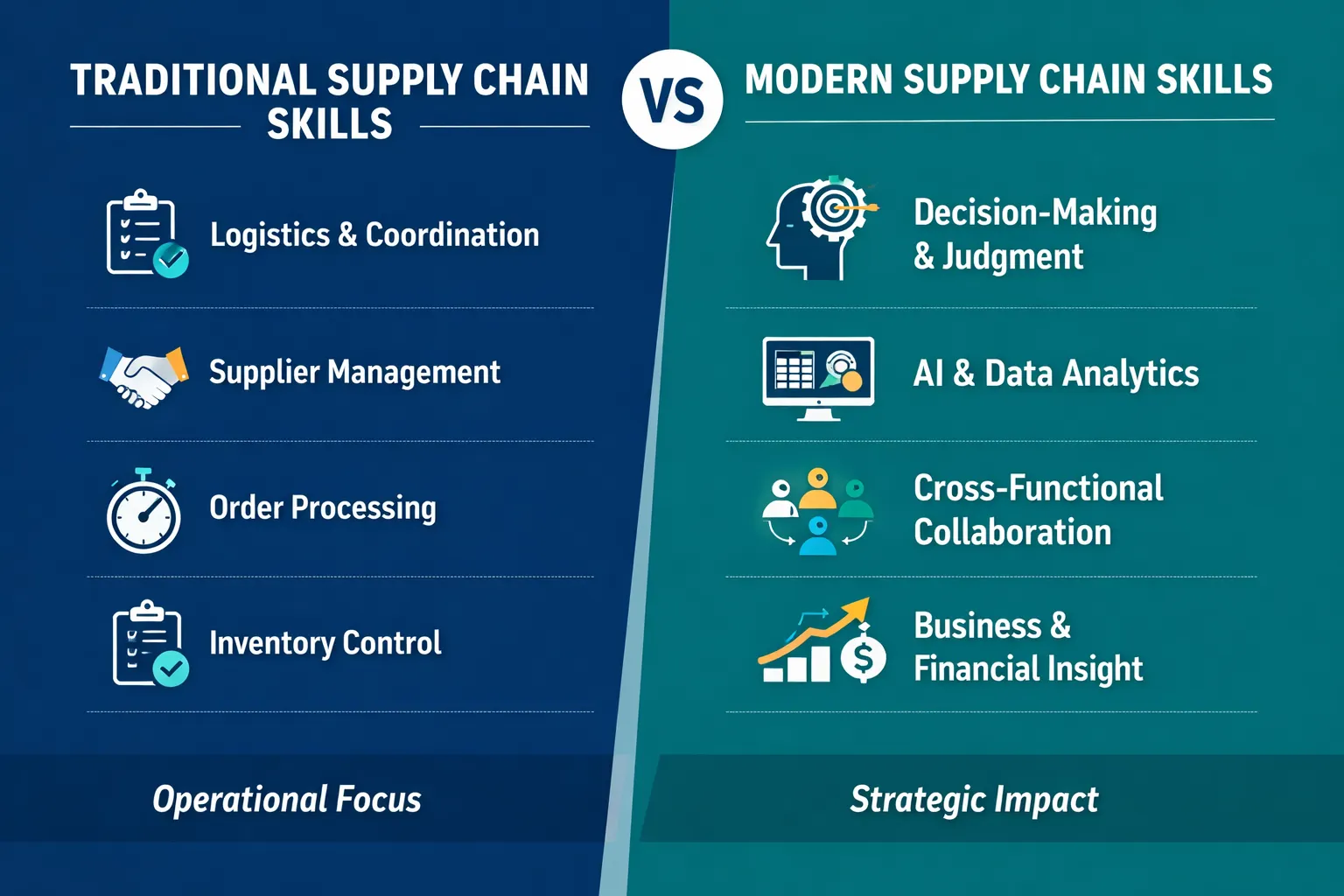
Supply Chain Trends for Executives: Where AI-Enabled Decision Support Matters Most in 2026
Supply Chain Trends for Executives: Where AI-Enabled Decision Support Matters Most in 2026
May 23, 2021
by: Corey Weekes
Supply chain trend articles are easy to find. Most mention the same themes: geopolitics, tariffs, resilience, AI, automation, risk, and cost pressure.
That is not the problem.
The problem is that many of these articles stop at the observation level. They describe what is happening around the business, but they do not go far enough on the question that matters most to executive teams: what decisions need to improve, where control is weak, and how those decisions affect cost, service, inventory, and working capital.
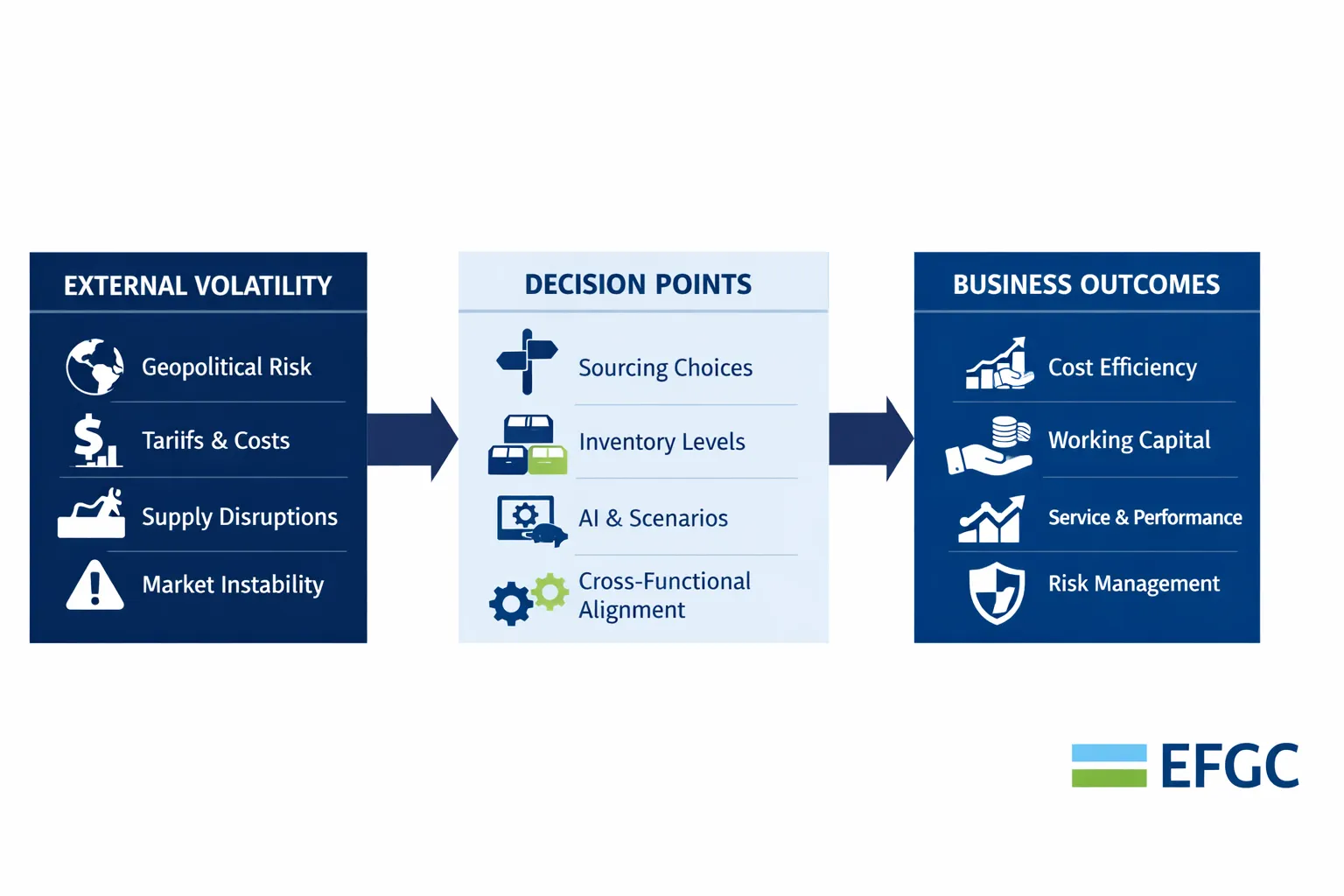
For CEOs, COOs, CFOs, and senior supply chain leaders, the central issue is not trend awareness.
It is decision quality that leads to EBIT improvement.
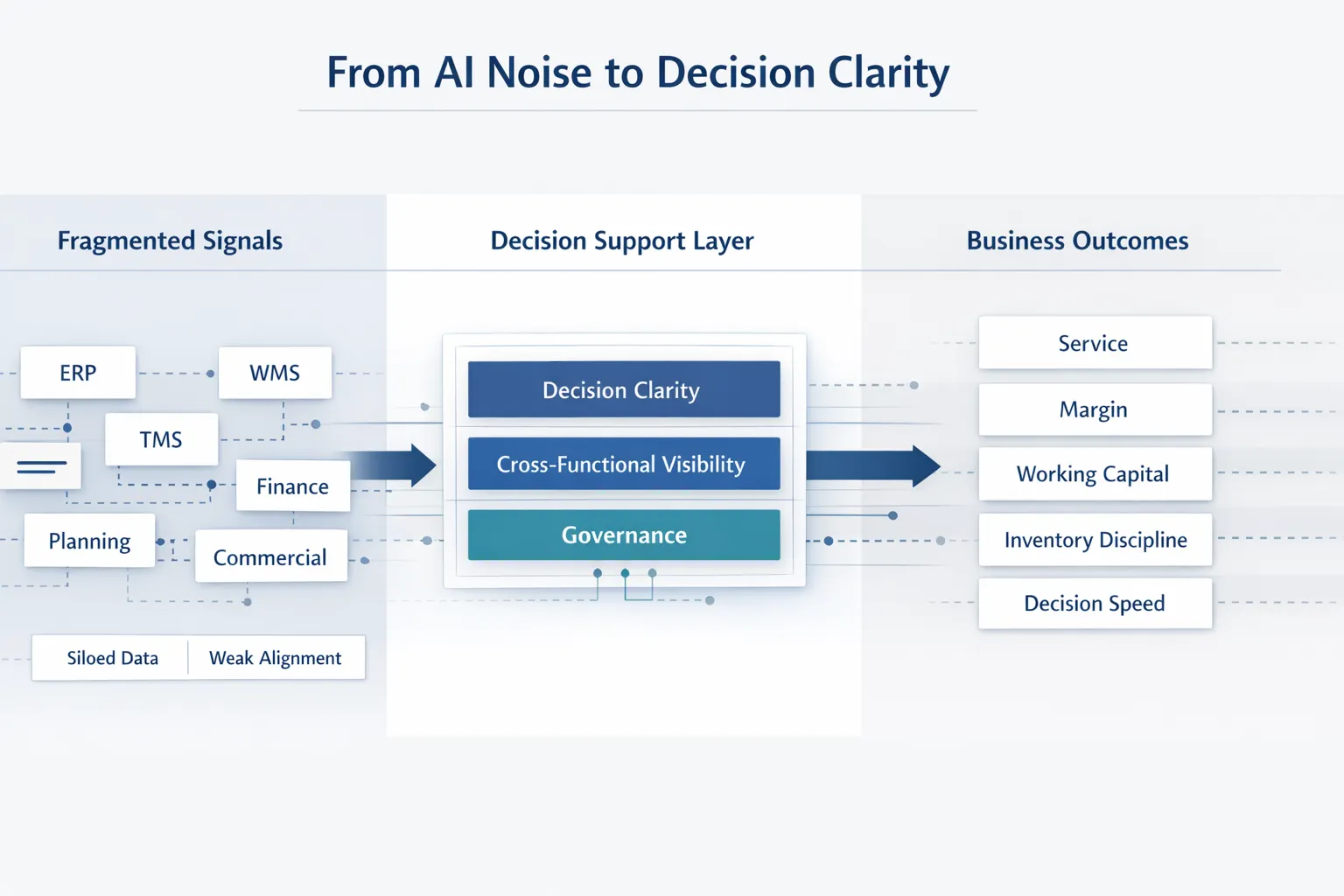
In 2026, the most important supply chain trend for executives is the shift from fragmented analysis toward AI-enabled decision support that helps teams respond faster, align across functions, and make more EBIT-driving, financially grounded supply chain decisions. That framing aligns directly with the EFGC brand direction to lead with decision clarity, stronger controls, cross-functional visibility, inventory discipline, and business reality.
Executive summary
The supply chain trends that matter most in 2026 are not just external disruptions. They are tests of internal decision capability.
Here is the executive version:
- Geopolitical fragmentation and tariff volatility are increasing the cost of slow decisions.
- Cost pressure is pushing inventory discipline and working capital back to the center of executive attention.
- AI is moving from experiment to operating expectation, but value will come from better decision support, not more dashboards or generic automation.
- Cross-functional visibility is becoming a control issue, not just a reporting issue.
- Scenario capability is becoming more important than static plan accuracy.
For CFOs in particular, the main question is this: can the organization make faster, clearer, more controlled supply chain decisions that improve cash, reduce avoidable cost, and strengthen service-cost tradeoffs?
Why broad trend lists are no longer enough
The usual 2026 themes are easy to recognize.
Most of the discussion around supply chain trends still focuses on external forces. That matters, but executive teams do not run the business by theme. They run it through decisions.
Should sourcing be shifted now or monitored longer?
Should inventory buffers be raised in one category and reduced in another?
Should customer service levels be protected at higher cost, or reset to preserve margin and cash?
Should AI be deployed into forecasting, exception handling, supplier risk, or scenario comparison first?
A trend list becomes useful only when it helps leadership answer those questions with more clarity.
That is why the real issue in 2026 is not whether the environment is volatile.
The issue is whether the organization has decision support that matches the environment it is operating in.
The real 2026 trend: AI-enabled decision support becomes an operating requirement
AI in supply chain is no longer a novelty topic.
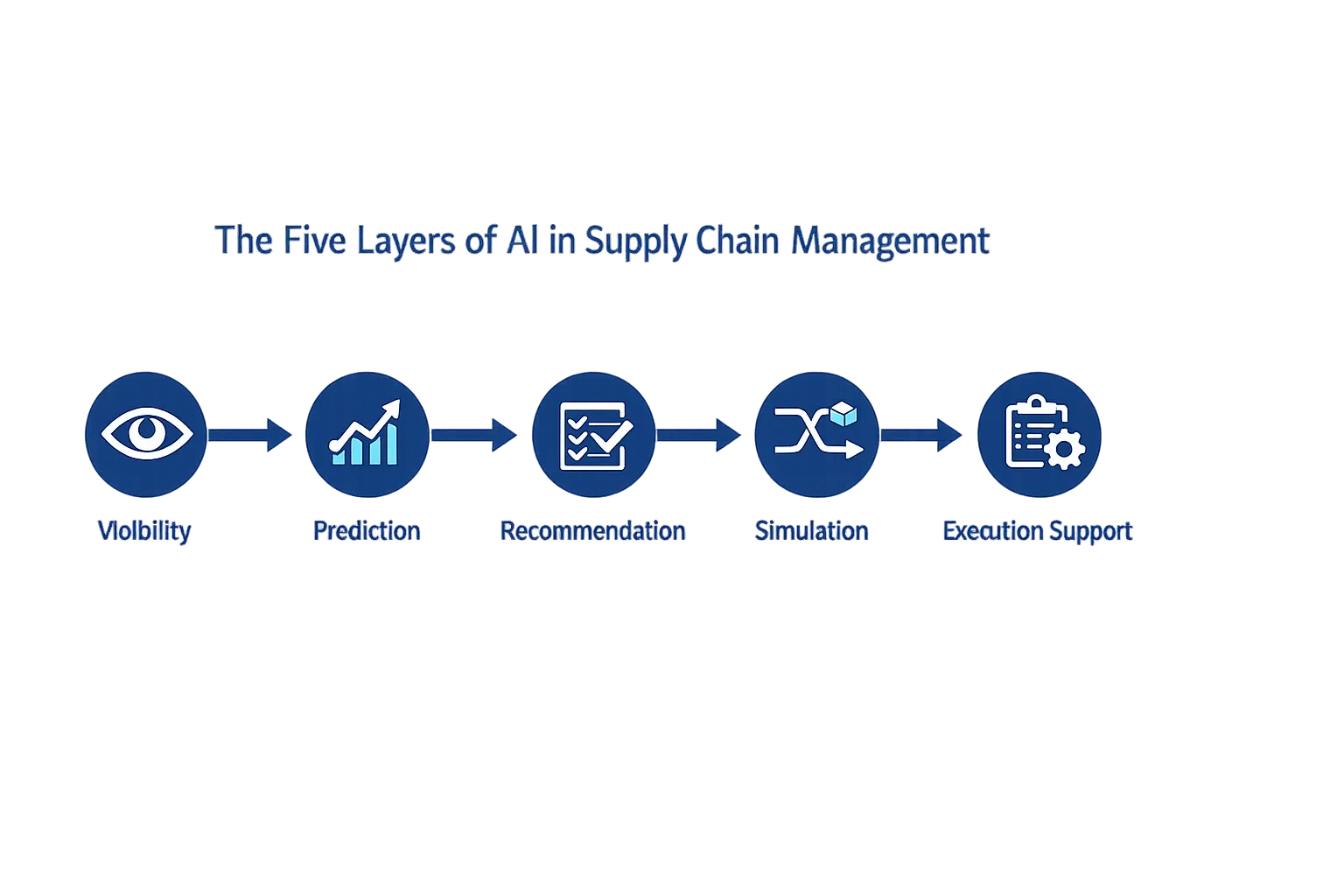
For executive teams, AI should not be treated as a standalone trend. It should be treated as a support layer for better decisions.
That means the right test is not:
“Are we using AI in supply chain?”
The better test is:
“Where does AI improve decision quality, reduce decision latency, strengthen controls, and clarify business tradeoffs?”
That shift matters because many organizations still have the same core problem.
They have more data than before, more tools than before, and more alerts than before, yet critical decisions are still slowed by fragmented visibility, manual escalation, conflicting assumptions, and weak linkage between operations and finance.
In that environment, AI creates value only when it helps leadership teams do at least one of four things:
- identify the decision that matters most now
- compare realistic scenarios faster
- show likely business impact more clearly
- support more aligned action across supply chain, finance, procurement, and commercial teams
This fits the EFGC positioning of AI for supply chain management grounded in business reality, with emphasis on decision support rather than hype or software-brochure language.
Trend 1: Trade fragmentation raises the cost of delayed response
Geopolitical risk is no longer a background condition. It is shaping sourcing, regionalization, supplier strategy, transportation assumptions, and cost exposure in real time.
The executive risk here is not just exposure.
It is decision delay.
When trade conditions move, slow organizations pay twice. First, they absorb direct cost through tariffs, disruptions, sourcing constraints, or service failures. Second, they absorb hidden cost through slow escalation, inconsistent responses, excess inventory, missed alternatives, and internal misalignment.
This is where AI-enabled decision support starts to matter.
A stronger decision-support model can help leaders compare sourcing alternatives faster, identify at-risk nodes earlier, assess inventory implications by category, and make cross-functional tradeoffs with less friction.
For CFOs, this matters because trade volatility quickly becomes a margin and cash issue.
Not every company can eliminate external risk.
Every company can improve how quickly and clearly it responds to it.
Trend 2: Working capital discipline is back at the center
Executive teams do not need another round of simplistic efficiency language. They need clearer control over the inventory, service, and cash tradeoffs that shape business performance.
Inventory is still one of the easiest places for decision weakness to hide.
Too much inventory can mask uncertainty, weak prioritization, and poor visibility.
Too little inventory can expose weak scenario planning, fragile supplier assumptions, and misjudged service commitments.
In both cases, the issue is not just stocking policy.
It is decision quality.
For CFOs, this brings working capital back into direct conversation with supply chain. The question is no longer just whether inventory is high or low. The better question is whether the inventory posture is aligned to current risk, customer commitments, margin priorities, and operating reality.
That is where AI-enabled decision support has practical value.
Used well, it can help teams compare the likely cash, cost, and service consequences of different inventory choices before those choices are locked in. It can also improve prioritization so that defensive inventory is not spread too broadly, too slowly, or too blindly.
This section is especially aligned to EFGC’s CFO audience guidance: cost reduction, working capital, inventory discipline, operational expense control, and financially grounded decisions.
Trend 3: AI hype is giving way to evidence, governance, and useful applications
Too much supply chain AI discussion still sounds like software theater. It over-focuses on tools and under-focuses on decisions.
Executives should be more disciplined than that.
The right use cases are the ones where AI helps improve a repeated decision under real constraints.
Examples include:
- demand and supply scenario comparison
- supplier risk monitoring and alternative evaluation
- event-driven prioritization
- exception triage
- inventory rebalancing logic
- execution decisions that need to be linked back to finance impact
The wrong use cases are the ones that generate more noise, more screens, and more local optimization without improving how the business actually decides.
This is also where governance matters.
If AI recommendations cannot be explained, challenged, or connected to business logic, executive confidence will remain weak. If the system does not support stronger controls, clearer assumptions, and better alignment across functions, then it may increase activity without improving decision quality.
That is why the 2026 conversation should move away from AI adoption as a vanity metric.
The better metric is whether AI is improving the speed, clarity, and quality of supply chain decisions that matter to the business.
"The most important supply chain trend in 2026 is not AI on its own. It is the move toward better decision support that helps leaders respond faster, align across functions, and make more financially grounded supply chain decisions."
Trend 4: Cross-functional visibility is becoming a control issue
Many organizations still treat visibility as a reporting problem.
It is not.
It is a control problem.
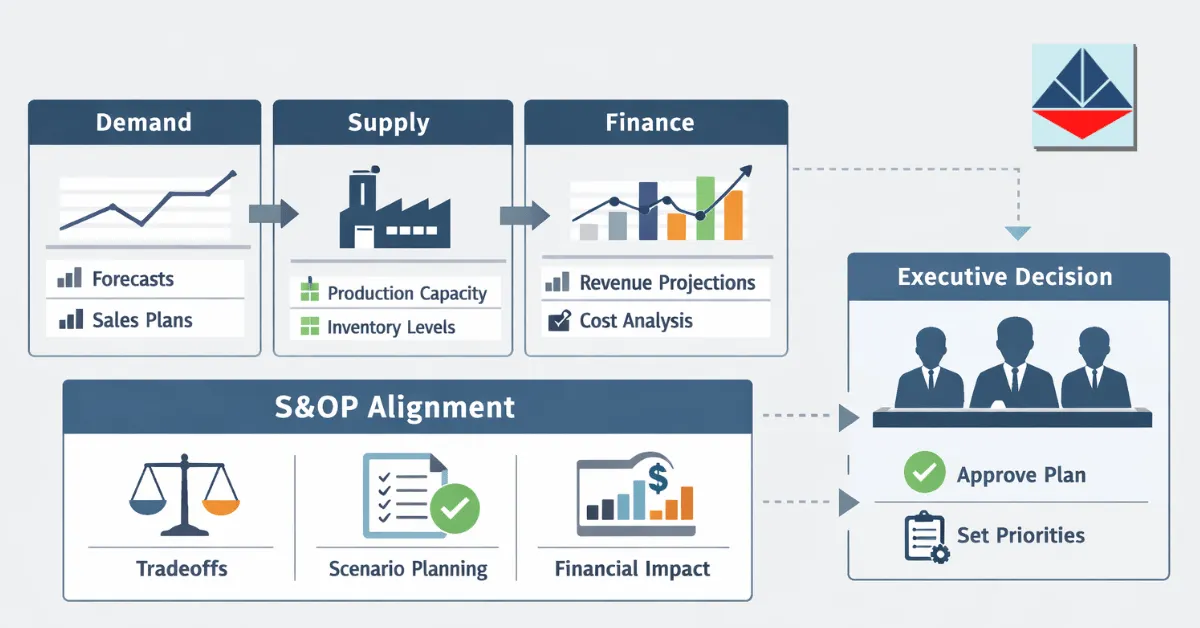
Supply chain leaders may be looking at one view of service risk. Finance may be looking at inventory and cash pressure through another. Procurement may be working from supplier assumptions that are not fully shared. Commercial teams may be driving demand and service expectations without a clear line of sight to operational constraints.
The result is familiar.
Decisions take too long.
Escalations multiply.
Tradeoffs are argued repeatedly.
No one is fully confident that the business is acting on a shared understanding of the issue.
This is why visibility on its own is not enough.
The executive need is cross-functional visibility that supports action.
That means the organization must be able to see the same issue through multiple lenses at once: operational impact, service implications, cost consequences, working capital effect, risk exposure, and timing urgency.
AI-enabled decision support can help here, but only if it is built to support cross-functional interpretation rather than narrow local decision-making.
This closely matches the EFGC promise to make the right information visible, usable, and aligned to business priorities.
Trend 5: Scenario capability matters more than static precision
Traditional planning systems often assume that better forecast accuracy will solve more of the problem than it actually does.
In 2026, that assumption looks weaker.
Trade conditions are moving. Supplier conditions are changing. Demand conditions are uneven in many sectors. Risk events are hitting faster and from more directions.
Under those conditions, the real advantage is not perfect prediction.
It is stronger scenario capability.
That means being able to compare meaningful options quickly, with assumptions that are visible and implications that are clear.
Executives should be asking:
- Can we see multiple realistic paths, not just one default plan?
- Can we compare service, inventory, cost, and cash tradeoffs before action is taken?
- Can finance and supply chain evaluate the same scenario using shared business logic?
- Can AI help reduce the time between signal, evaluation, and action?
This is where mature decision support becomes more valuable than static forecasting rhetoric.
Scenario capability improves agility without reducing discipline. It gives leaders a clearer basis for action when conditions move and helps avoid reactive decisions made under pressure with weak alignment.
What executives should ask now
Leadership teams do not need a bigger trend library.
They need sharper questions.
Which recurring supply chain decisions create the most financial exposure when they are delayed?
Look for decisions that affect inventory, service, sourcing, margin, or working capital.
Where are we still relying on fragmented spreadsheets, siloed assumptions, or manual escalation?
That is often where decision latency and control failures are hiding.
Which tradeoffs are still being argued function by function instead of evaluated together?
This usually points to weak cross-functional visibility.
Where could AI improve decision speed or quality without weakening governance?
Focus on repeatable, high-friction decisions first.
Can we connect supply chain decisions more clearly to finance outcomes?
If the answer is no, the business is likely under-using both its data and its decision processes.
Are we measuring AI activity or decision improvement?
The second one is what the executive team should care about.
A simple maturity model for 2026
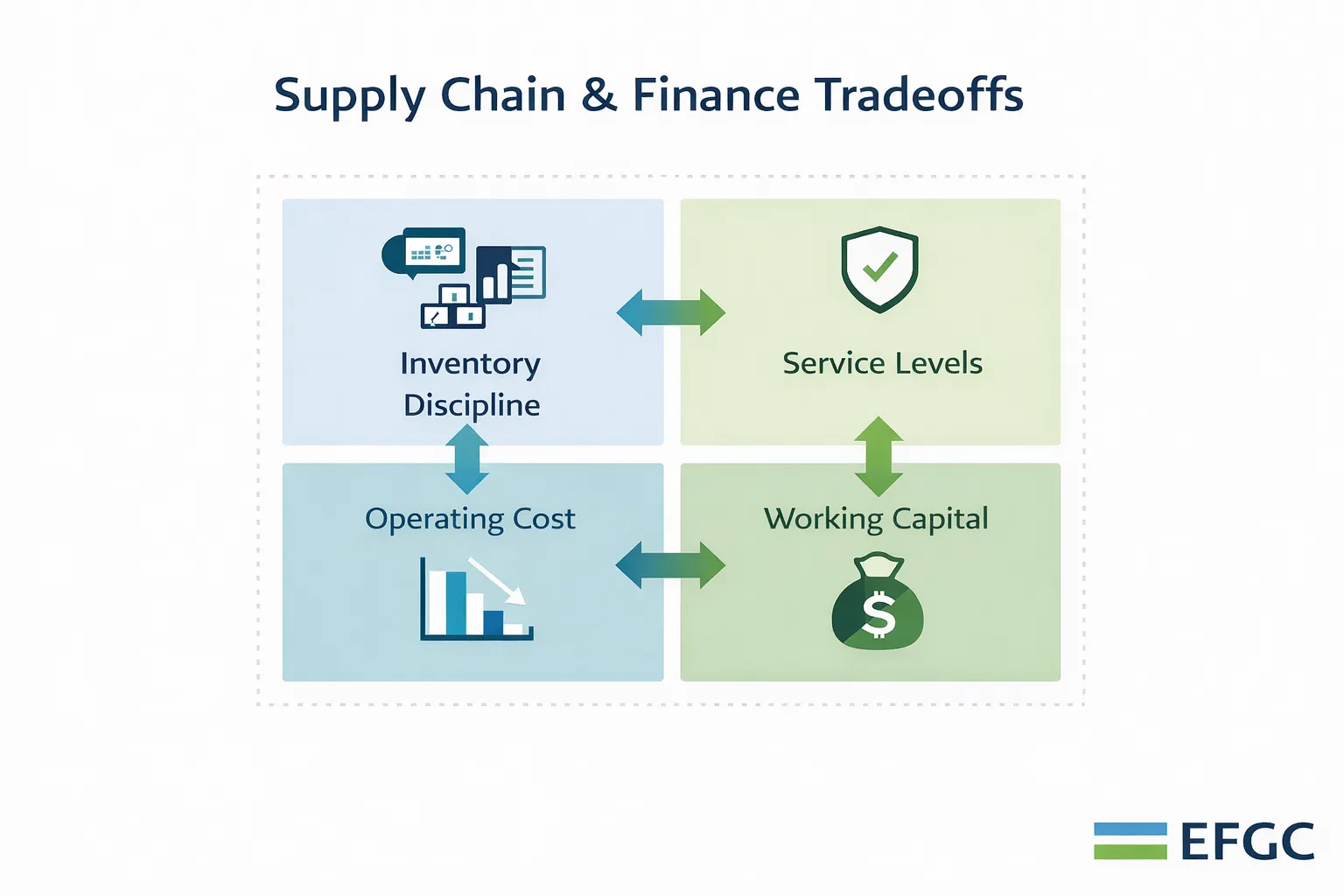
One useful way to assess readiness is through a simple four-level decision-support maturity model.
Level 1: Fragmented signals
Data exists, but it is scattered. Teams rely heavily on manual interpretation and local views.
Level 2: Shared visibility
More information is available across functions, but decision logic is still inconsistent and escalation remains slow.
Level 3: Scenario-backed decisions
Teams can compare options more clearly and make tradeoffs with stronger cross-functional input.
Level 4: AI-enabled decision support
AI helps surface priorities, compare scenarios, reduce decision latency, and strengthen control without replacing executive judgment.
Most organizations are somewhere between Levels 1 and 3.
That matters, because many AI conversations assume the company is more ready than it is.
The practical executive goal for 2026 is not to jump to a fully autonomous future.
It is to move toward stronger decision support in the places where the business is currently slow, fragmented, or financially exposed.
Final thought
The most important supply chain trends for executives in 2026 are not just external trends.
They are signals about the quality of the internal decision system.
Geopolitical fragmentation, cost pressure, tariff exposure, supplier instability, and AI expansion all matter. But none of them can be managed well with fragmented visibility, weak controls, or poor linkage between operations and finance.
That is why AI-enabled decision support matters now.
Not because it sounds advanced.
Because executive teams need faster, clearer, more aligned, and more financially grounded supply chain decisions.
That is the standard.
And in 2026, it is becoming the real competitive divide.
Book a Consultation
Discuss where AI-enabled decision support can improve decision clarity, cross-functional visibility, inventory discipline, and financially grounded supply chain decisions in your organization.