What Is AI in Supply Chain Management? What It Actually Means in Practice
What Is AI in Supply Chain Management? What It Actually Means in Practice
Mar 30, 2026
by: Corey Weekes
Supply chain leaders are under pressure to make faster decisions in more volatile conditions. Demand shifts quickly. Supply risk appears with less warning. Cost pressure remains high. Service expectations do not ease. In that environment, the real question is not whether AI sounds promising. The real question is whether it helps people make better supply chain decisions in the conditions they actually face.
AI in supply chain management is often explained in software terms. That is where many definitions become less useful. In practice, AI matters when it improves how decisions are made across planning, inventory, sourcing, logistics, and cross-functional execution. It should help teams see what matters earlier, evaluate tradeoffs more clearly, and act with stronger alignment across operations, finance, and leadership. That is what makes better supply chain decisions possible in business reality.
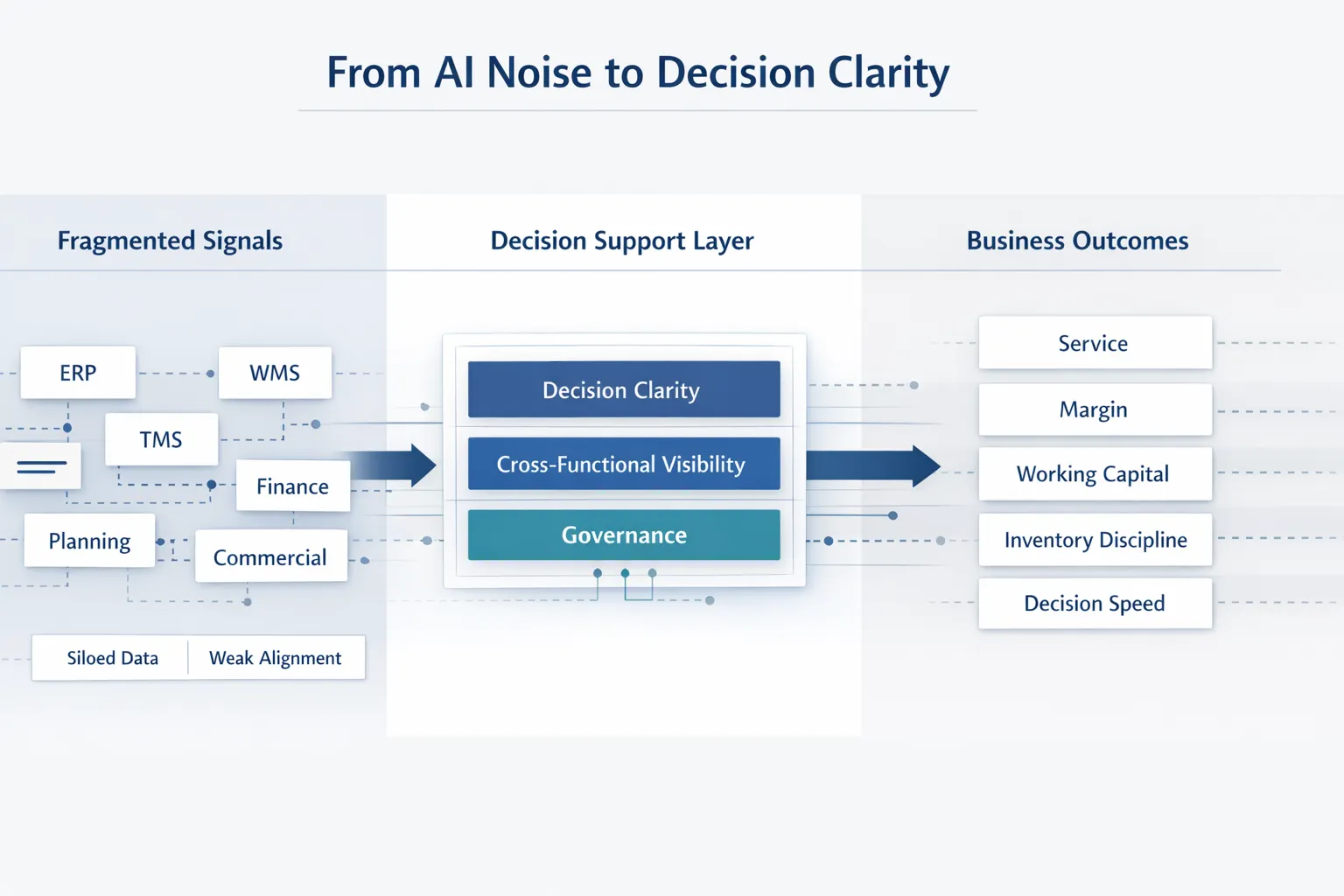
AI in SCM is not valuable because it sounds advanced. It is valuable when it improves decision clarity, strengthens controls, reduces decision latency, and supports more business-aligned action. That is the difference between AI as a feature and AI as decision support.
Executive Summary
AI in supply chain management is not just automation, dashboards, or chat interfaces layered on top of planning systems. It is most useful when it improves decision quality across service, cost, inventory, and working capital. The strongest use cases improve visibility, reduce decision latency, strengthen controls, and support clearer tradeoffs across functions. That is where value becomes practical. That is also where many organizations discover the gap between AI marketing and AI that actually works.
What AI in supply chain management actually means
The phrase is broad because the category is broad. AI in supply chain management is not one tool, one platform, or one project. It is a set of capabilities that support better decisions across the supply chain.
In simple terms, AI in supply chain management means using data, models, and AI-enabled tools to support better supply chain decisions across planning, inventory, risk, logistics, and cross-functional execution.
In practice, those capabilities usually fall into five groups.
- Pattern recognition helps teams identify changes, anomalies, and emerging risks in large volumes of data.
- Prediction supports demand forecasting, lead-time estimation, delay risk signals, and other forward-looking assessments that help teams prepare earlier.
- Recommendation helps identify better response options, such as stock reallocations, replenishment adjustments, sourcing alternatives, or operating responses.
- Simulation helps teams compare likely outcomes before they act, so they can see how choices may affect cost, service, inventory, and capacity.
- Execution support helps teams summarize issues, prioritize exceptions, and move decision processes forward with greater consistency.
Seen this way, the most useful definition of AI in SCM is not software capability alone. It is AI-enabled decision support that improves how the business actually operates. This matches our emphasis on visibility, control, alignment, and business-grounded decision quality.
What AI is not
A lot of confusion starts here.
AI is not the same as digital transformation. A company can invest heavily in systems and still struggle with fragmented visibility, unclear ownership, and slow decisions.
AI is not a replacement for supply chain judgment. It can support judgment, sharpen it, and improve confidence. It does not remove the need for business context, operating experience, or accountability.
AI is not automatically useful because it is embedded in a platform. If it does not improve a real decision, it is just another feature.
AI is not a shortcut around weak data, weak process discipline, or weak cross-functional alignment. If the underlying decision environment is unclear, AI can simply surface more noise faster.
AI is also not only generative AI. Generative tools can help summarize, explain, and support communication, but they are only one part of the picture. Supply chain AI also includes prediction, anomaly detection, recommendation logic, and scenario evaluation.
These distinctions matter because many organizations are not buying decision improvement. They are buying the idea that AI will solve problems they have not clearly defined. That usually leads to activity without much improvement in outcomes.
Why AI in supply chain management matters now
Supply chain decisions have become harder to make well.
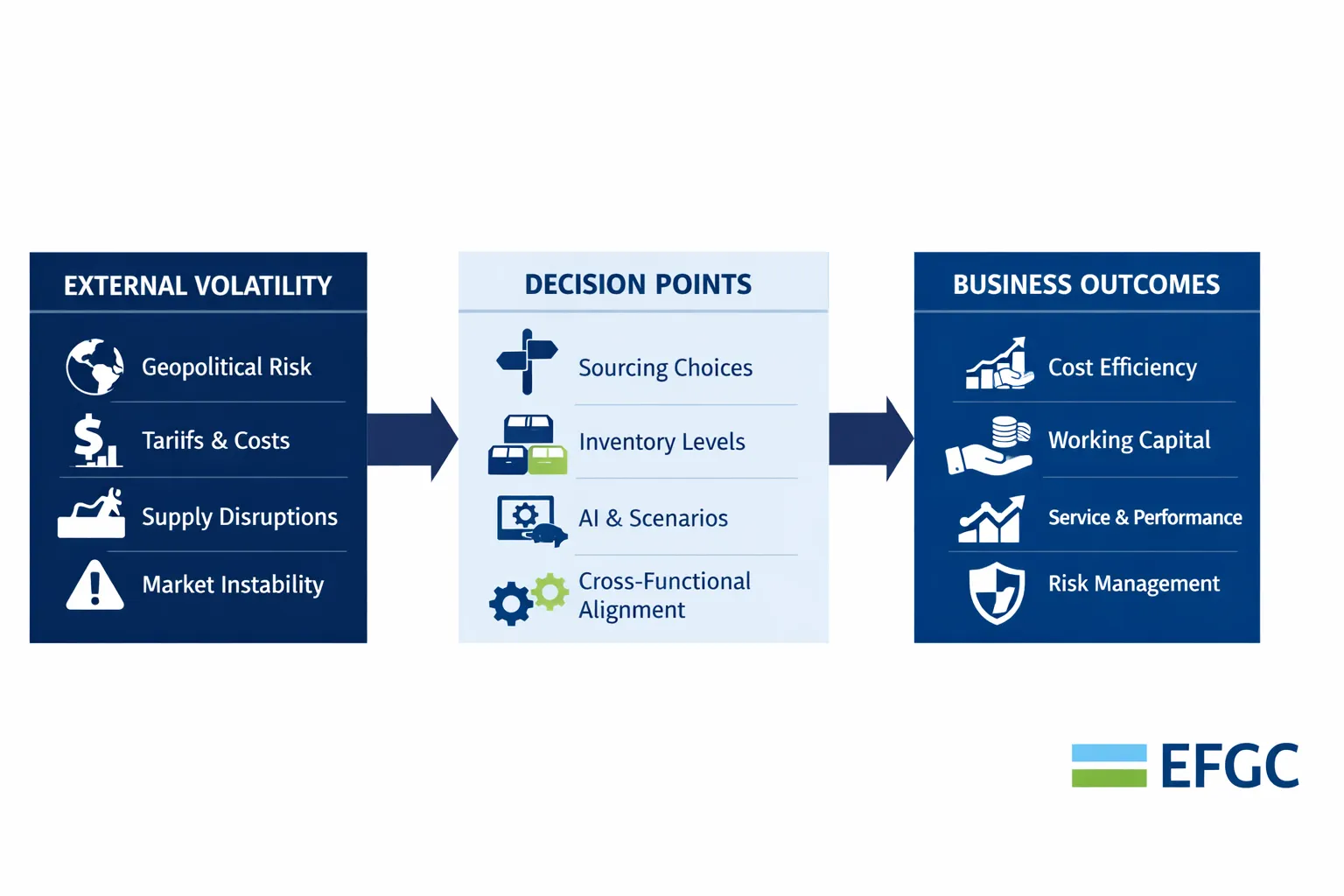
Volatility has become more normal. Demand patterns move. Supplier risk changes quickly. Trade conditions shift. Costs fluctuate. Teams are expected to respond faster while keeping service stable and capital under control.
At the same time, many organizations already have more data than they can use well. The issue is not only visibility. The issue is turning visibility into better decisions. That requires support that can reduce noise, highlight what matters, and help leaders act with more clarity under pressure.
This is where AI becomes relevant. Not because it is new, but because the cost of slow, siloed, low-confidence decisions is harder to absorb. When inventory builds in the wrong place, when service tradeoffs are made too late, or when operations and finance are working from different assumptions, the business pays for it. AI has value when it helps reduce those gaps.
Where AI creates real value in practice
The strongest way to understand AI in SCM is to look at the actual decisions it can support.
Demand sensing and forecasting
Forecasting remains one of the clearest use cases. AI can help detect demand shifts earlier, incorporate more relevant signals, and improve forecast quality when historical averages alone are too slow or too blunt.
That does not remove uncertainty. What it can do is improve the quality of the signal and help teams respond sooner. That matters because better forecasting affects inventory exposure, service risk, and cross-functional confidence.
Inventory discipline
Inventory is one of the most important areas where supply chain AI should be judged. Can it help leaders understand what stock is at risk, where inventory is misaligned to demand, what should be rebalanced, and which policies are increasing capital strain without improving service?
This is where AI becomes commercially relevant. Stronger inventory discipline supports working capital, reduces unnecessary stock buildup, and improves tradeoffs between service and cost.
Supply and risk visibility
AI can help surface risks earlier across suppliers, lead times, shortages, logistics constraints, and operational exceptions. The value is not simply alerting. The value is highlighting what requires action and helping teams focus on the disruptions most likely to affect business outcomes.
Logistics and transport decisions
In logistics, AI can support route choices, ETA risk signals, capacity decisions, and exception prioritization. This is useful when transport conditions are unstable or when service and cost pressures must be balanced quickly.
Scenario analysis and simulation
One of the most practical uses of AI is helping teams compare options before they act. That could mean assessing how a sourcing change affects service. It could mean testing how inventory reductions affect working capital and fill rate. It could mean comparing operational responses to a disruption before taking a costly step.
This is where supply chain AI becomes more strategic. It supports cause-and-effect thinking rather than reaction alone.
Workflow and communication support
Generative AI is useful here. It can help summarize complex issues, draft internal updates, support supplier communications, and turn raw signals into more usable decision inputs.
That may sound smaller than forecasting or risk models, but it still matters. Many supply chain decisions are slowed by fragmented information and inconsistent communication. Better support around the decision process can reduce delay and improve alignment.
Cross-functional decision support
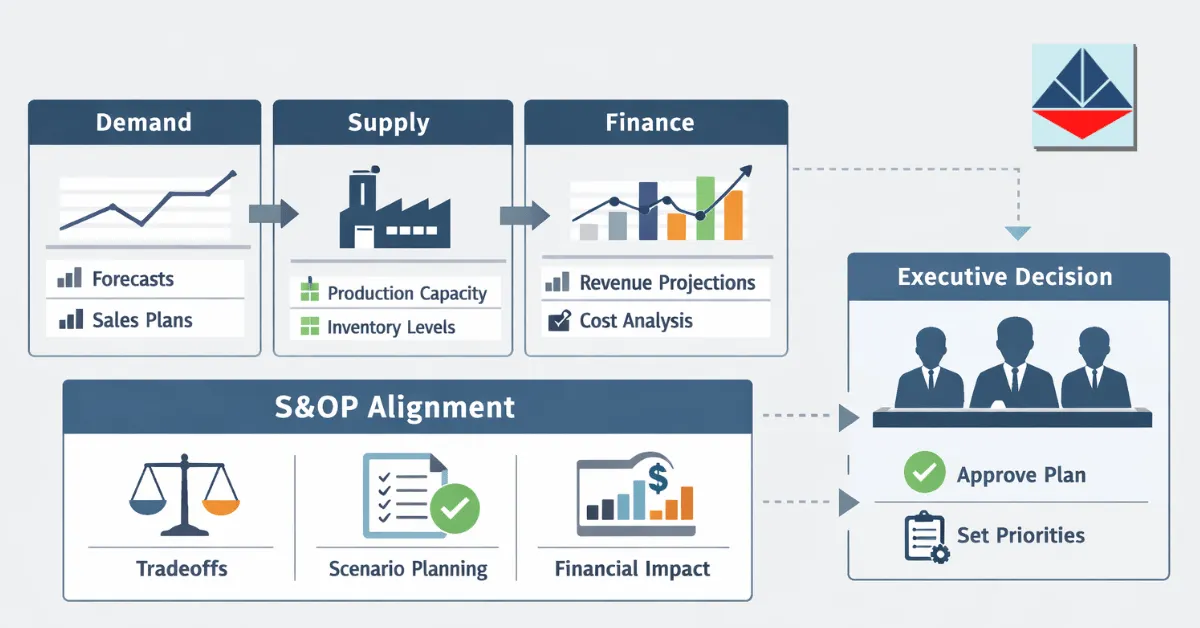
This may be the most important area of all. Supply chain decisions rarely stay inside supply chain. They affect finance, operations, commercial priorities, customer outcomes, and capital. Good AI should make those tradeoffs easier to see. It should support stronger cross-functional visibility so supply chain, finance, and operations can act on the same business reality.
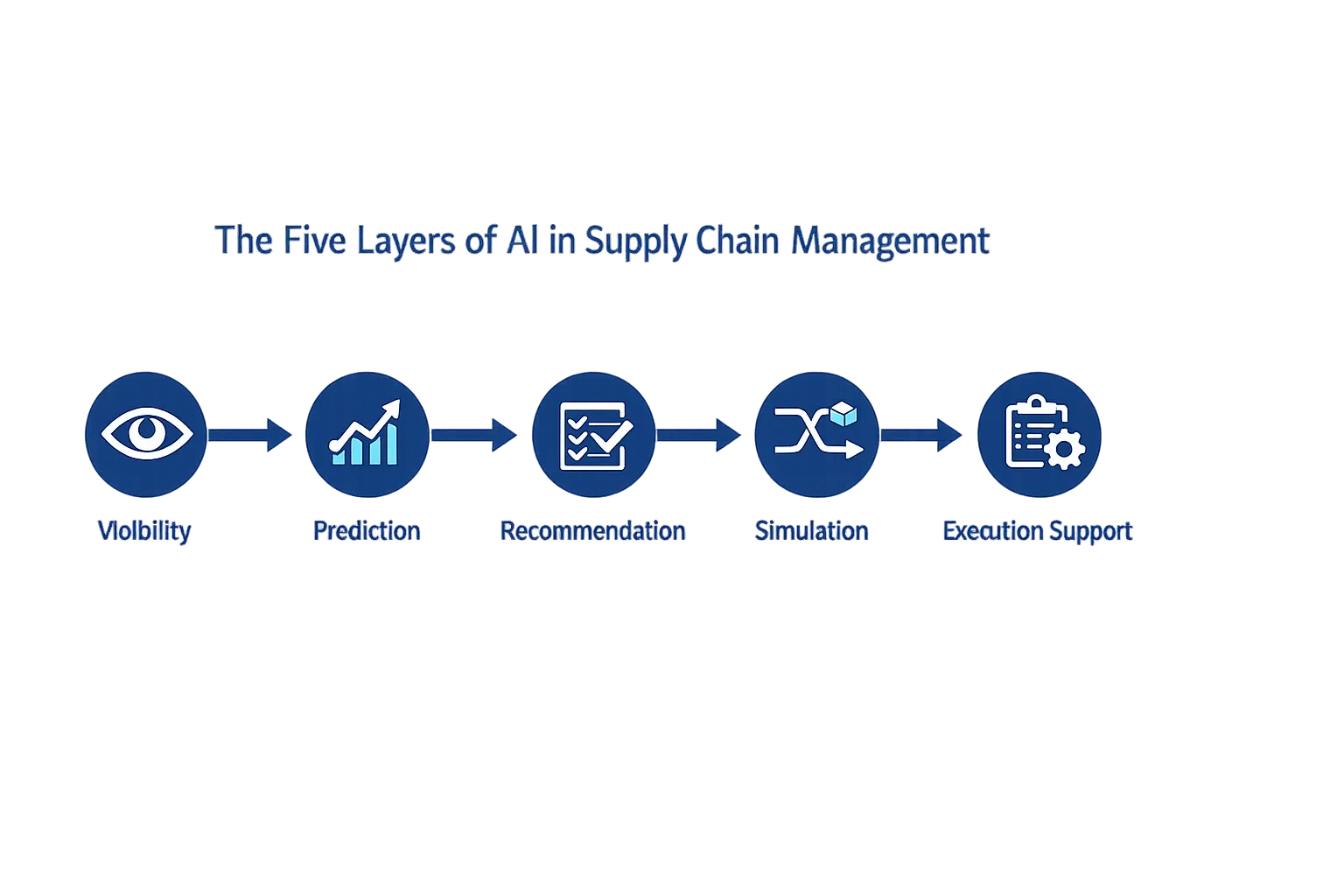
The five layers of practical AI in supply chain management
A useful way to think about supply chain AI is in five layers.
1. Visibility
What is happening right now that matters?
2. Prediction
What is likely to happen next?
3. Recommendation
What response options make sense?
4. Simulation
What are the likely consequences of each option?
5. Execution support
How do we help teams act faster and more consistently?
Organizations often stop at visibility. They build dashboards and call it intelligence. That is not enough. The value increases when teams move beyond reporting into clearer recommendations, better scenario evaluation, and stronger support for execution.
Visual: The Five Layers of Practical AI in Supply Chain Management
Visibility → Prediction → Recommendation → Simulation → Execution Support
Where AI in supply chain management is most often misunderstood
This is where many supply chain AI efforts lose momentum.
One common misunderstanding is confusing reporting with intelligence. A dashboard can show what happened. That does not mean it helps people make better decisions.
Another is confusing automation with decision quality. Faster workflows are useful, but they do not automatically produce better outcomes. A bad decision made faster is still a bad decision.
Another mistake is assuming AI can overcome poor data discipline. It cannot. If product data, planning assumptions, ownership rules, or business logic are weak, AI will struggle to generate trust.
Another misunderstanding is treating AI as a substitute for planners, operators, or leadership judgment. Good AI should support better human decisions. It should not remove accountability from the people who own the outcome.
Many organizations also overfocus on pilots that never connect to day-to-day decisions. They prove a model can run but fail to prove that it improves decision quality in a way a real team will trust and use.
A final misunderstanding is ignoring finance. Supply chain AI should not be judged only on technical performance or forecast accuracy. It should also be judged on whether it improves inventory discipline, strengthens service decisions, reduces avoidable cost, and supports more financially grounded decisions.
Common misunderstandings
- More dashboards means more intelligence
- Faster automation means better decisions
- AI can fix weak data and weak process discipline
- Generative AI is the whole story
- Supply chain AI can be judged without finance in the conversation
What good AI in SCM looks like in a real business
Good AI in supply chain management is connected to real decision points.
It is designed around decisions that are currently slow, fragmented, or low-confidence.
-> It uses data that people trust enough to act on.
-> It makes tradeoffs easier to see across supply chain, finance, and operations.
-> It reduces noise rather than adding another layer of analysis.
-> It fits how the business actually operates.
-> It supports stronger controls, not just more outputs.
-> It is measured through business outcomes, not only technical metrics.
A simple test is this: if the AI disappeared tomorrow, would a real decision get worse, slower, or less aligned? If the answer is no, the tool may be interesting, but it is not yet creating meaningful value.
A quick test for leaders
- Does it improve a real decision?
- Does it reduce decision latency?
- Does it strengthen control?
- Does it clarify cross-functional tradeoffs?
- Can people trust and act on it?
- Is business ownership clear?
The role of generative AI, machine learning, and AI agents in supply chain management
These terms are often grouped together, but they do different jobs.
Machine learning is usually strongest in prediction and pattern recognition. It can help identify demand shifts, anomalies, risk patterns, and likely outcomes based on large data sets.
Recommendation and optimization approaches help compare choices and identify better operating responses under constraints.
Generative AI is useful for summarizing, explaining, drafting, and translating information into more usable forms. It can help people engage with supply chain data more easily, but it should not be mistaken for the full definition of supply chain AI.
AI agents can help coordinate tasks across workflows under defined rules. That may become useful in exception handling, information routing, or routine process support. But the same rule still applies. If the agent does not improve a real decision or process outcome, its value is limited.
The business case for AI in supply chain management
The business case should be clearer than “we are becoming more advanced.”
A practical business case usually includes better inventory discipline, lower avoidable cost, faster response to meaningful exceptions, improved service decisions, reduced decision latency, stronger working capital visibility, clearer cross-functional alignment, and more financially grounded supply chain decisions.
These outcomes matter because supply chain performance is not separate from business performance. Decisions around supply, stock, service, sourcing, and operations shape capital use, customer outcomes, and operating cost. AI has value when it helps leaders make those tradeoffs with more clarity and better timing.
What leaders should ask before investing in supply chain AI
Before investing, leaders should slow down enough to ask better questions.
- Which decisions are currently slowed by fragmented visibility or weak alignment?
- Where is inventory, service, or cost being affected by poor decision support?
- Which supply chain decisions need stronger connection to finance?
- What data is already available and usable enough to support action?
- Where would scenario analysis improve confidence before action is taken?
- What would success look like in operational terms and in business terms?
- Where should human review, ownership, and governance stay firmly in place?
These questions tend to produce better outcomes than starting with a vendor feature list.
A practical starting point for organizations
A practical starting point is rarely to deploy AI everywhere. It is usually much narrower.
Start by identifying one important decision environment. Focus on a problem where the business cost of poor decisions is visible. That may be inventory exposure, service instability, supply risk response, or cross-functional misalignment around planning.
Then map the visibility gaps, the decision bottlenecks, and the tradeoffs that matter most.
From there, choose the type of AI support that fits the actual need. That might be forecasting support. It might be risk detection. It might be stronger scenario analysis for higher-stakes decisions. It might be decision memo support for a high-friction process.
Pilot it in a way that can be measured. Judge it by whether it improves decision quality, clarity, timing, and business alignment. Then scale from what proves useful.
That kind of approach is slower than hype, but much more likely to create practical value.
Conclusion: AI in supply chain management only matters when it improves decisions
AI in supply chain management is easy to describe in technology terms. It is harder, and more useful, to define it in business terms.
In practice, AI should help organizations improve how supply chain decisions are made. It should strengthen visibility, sharpen judgment, clarify tradeoffs, and support more disciplined action across cost, service, inventory, and capital.
That is what it actually means in practice.
And that is also where many organizations should be more demanding. Not more excited. More demanding.
If your organization is exploring AI for supply chain management and wants to focus on where it can improve real decisions, not just add more technology, Book a Consultation.
FAQ section
What is AI in supply chain management?
AI in supply chain management means using data, models, and AI-enabled tools to support better decisions across planning, inventory, logistics, risk, and cross-functional execution.
How is AI used in supply chains?
It is used for forecasting, inventory decisions, risk detection, logistics support, scenario analysis, exception management, and selected workflow support.
Can AI improve inventory management?
Yes, when it helps teams make better decisions around stock positioning, replenishment, allocation, exception handling, and working capital discipline.
What is the difference between automation and AI in supply chain management?
Automation helps tasks move faster. AI is most useful when it helps people make better decisions, not just faster ones.
Does AI replace supply chain planners?
No. It should support planners and decision-makers, not remove the need for human judgment, context, and accountability.
What are the risks of AI in supply chain management?
Common risks include weak data quality, low trust in outputs, poor alignment to real decisions, weak governance, and overreliance on tools that do not improve business outcomes.
How should companies start using AI in supply chain management?
Start with one high-value decision problem, map the visibility and control gaps, select the right support approach, and measure results in business terms.
Explore Where AI Can Improve Real Supply Chain Decisions
If you are assessing where AI can support decision clarity, inventory discipline, and cross-functional visibility in your organization, book a consultation to discuss where it can create practical value.