Why “AI-Powered ERP” Is Not a Supply Chain Strategy
Why “AI-Powered ERP” Is Not a Supply Chain Strategy
May 23, 2026
TL;DR
- AI-powered ERP can improve visibility, automate workflows, and accelerate operational processes. But it is not a supply chain strategy.
- ERP systems are tools for recording transactions and coordinating enterprise activity. Strategy still requires deliberate choices around inventory, service levels, planning discipline, supplier risk, governance, decision rights, and operational accountability.
- The companies that succeed with AI will not simply buy AI-enabled software. They will redesign how decisions are made across the supply chain so they can improve service, cost, cash flow, resilience, profitability, and ROCE.
- Technology can accelerate execution. But if the operating model is weak, automation simply scales inefficiency faster.
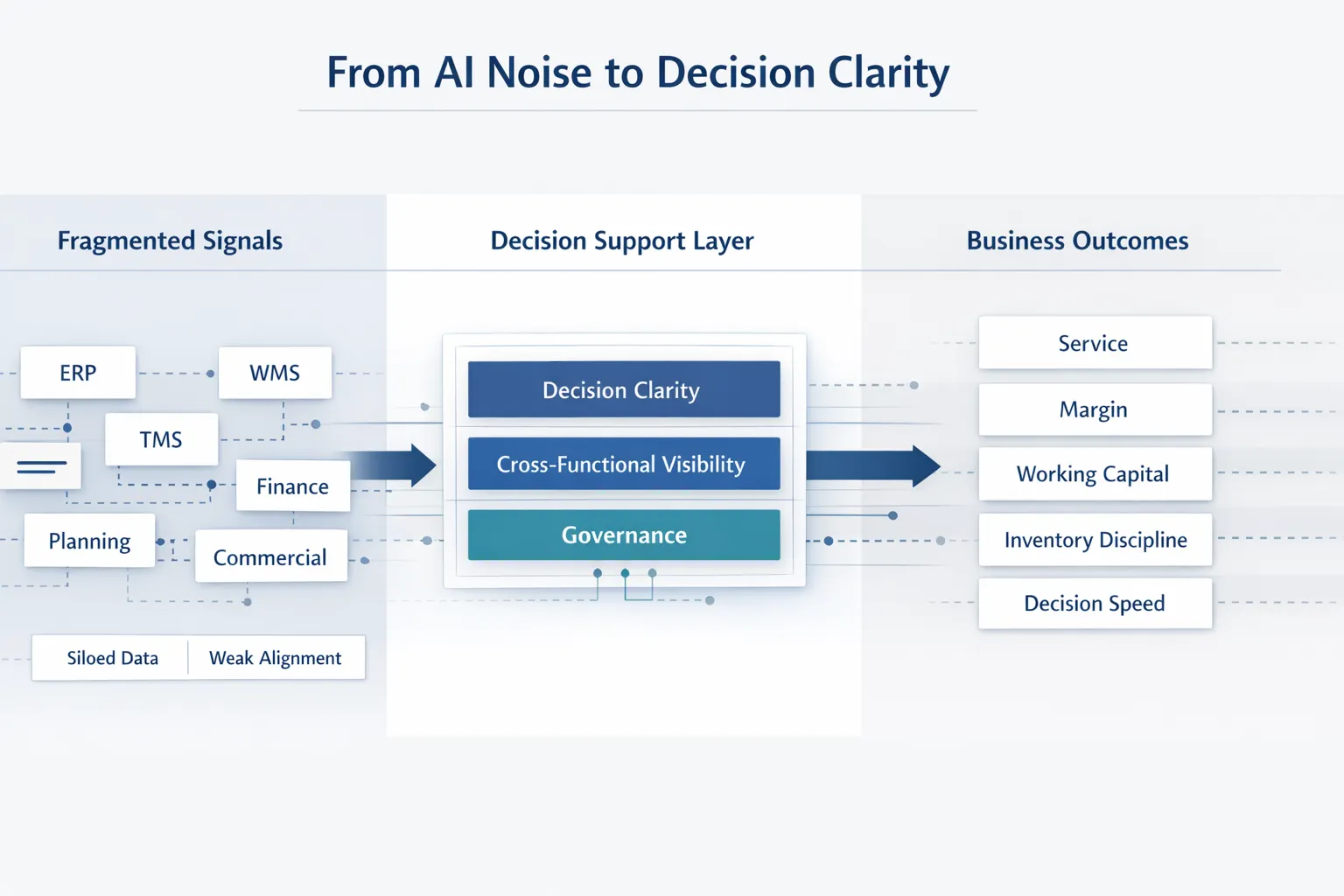
- The real opportunity is not AI-powered ERP on its own. It is AI-enabled supply chain decision support that connects planning, execution, finance, and governance into a clearer operating system.
Introduction
ERP vendors are increasingly positioning themselves as AI companies.
The messaging is everywhere: embedded AI, predictive automation, intelligent workflows, digital assistants, and autonomous operations. The promise is compelling. Add AI into the ERP environment, automate repetitive tasks, generate smarter recommendations, and create a more responsive enterprise.
For executives under pressure to improve efficiency while managing volatility, the sales pitch is attractive.
But supply chains do not fail because the ERP screen lacks an AI button.
They fail because decisions are disconnected. Data arrives late or cannot be trusted. Inventory policies are unclear. Suppliers miss commitments. Planners are overloaded with manual firefighting. Departments operate with conflicting incentives. Leadership teams pursue automation without fixing operational accountability first.
This is the gap many organizations underestimate.
AI-powered ERP may improve workflows and increase visibility, but it does not automatically create a resilient or profitable supply chain. Technology can support execution, but it cannot replace the operating decisions that define strategy.
That distinction matters because supply chain performance improves only when technology strengthens decision clarity, cross-functional control, and accountability in the real operating model.
For organizations evaluating practical AI for supply chain management solutions, the starting point should not be, “What AI features does the ERP vendor offer?”
The better question is:
Which supply chain decisions must become faster, clearer, better governed, and more financially grounded?
AI-Powered ERP Is a Tool, Not the Operating Strategy
ERP Answers “What Happened.” Strategy Answers “What Should We Do Next?”
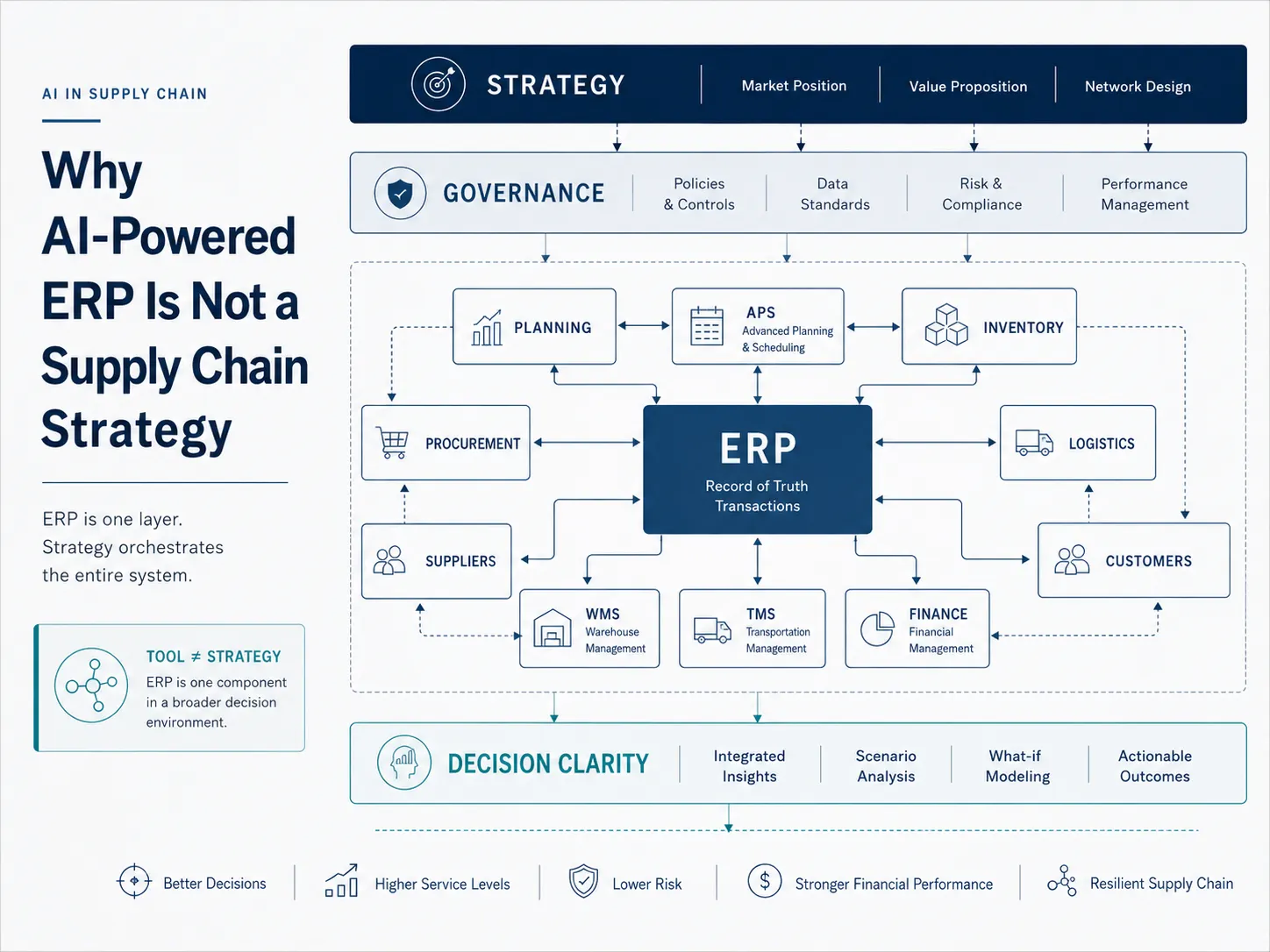
ERP systems are essential because they act as the operational backbone of the business. They capture orders, inventory balances, procurement activity, production schedules, financial transactions, and logistics data.
But ERP is primarily a system of record.
Supply chain strategy is a system of choices.
Organizations still need to define:
- How they will serve customers
- Where inventory should sit
- Which tradeoffs they will accept
- How they will manage supply disruptions
- Which priorities matter most when cost, service, and cash collide
- How working capital should be protected without weakening service
- Which decisions can be automated and which require human approval
AI can support these decisions. It cannot define the business philosophy behind them.
This matters because many companies are confusing software capability with operational capability. Buying AI-powered ERP does not automatically create an AI-ready supply chain.
A stronger approach starts with the decision environment. What needs to be seen? What needs to be controlled? Who owns the decision? What financial outcome is being protected? What happens when service, cost, inventory, and capacity compete?
Those are strategy questions before they are software questions.
Why Workflow Automation Is Not the Same as Decision Orchestration
Most embedded AI features focus on workflow automation:
- Alerts
- Recommendations
- Automated approvals
- Exception notifications
- Administrative task reduction
These capabilities are useful. They improve speed and reduce friction.
But supply chains are not won through isolated automation alone. They are won through coordinated decision-making across planning, procurement, operations, logistics, finance, and customer service.
That requires orchestration.
An AI-generated recommendation may improve one function while unintentionally damaging another if governance and priorities are unclear. A replenishment action may protect service but inflate inventory. A transportation decision may reduce delay but damage margin. A supplier decision may protect near-term continuity while increasing long-term risk.
A faster disconnected process is still a disconnected process.
This is why a true AI-powered operating layer for supply chain decision support must connect execution to medium-term planning, longer-term priorities, and finance impact. It should not simply add more alerts to an already noisy operating environment.
The Boardroom Risk
One of the biggest executive risks today is assuming AI-enabled software automatically creates business transformation.
It does not.
True supply chain capability still requires:
- Trusted data
- Clear ownership
- Planning discipline
- Governance frameworks
- Cross-functional accountability
- Workforce readiness
- Defined escalation paths
- Financially grounded performance measures
Without those foundations, AI-powered ERP becomes advanced technology layered on top of unresolved operational confusion.
The board-level question is not whether the ERP has AI.
The question is whether supply chain decisions are improving service, reducing avoidable cost, protecting margin, releasing working capital, and strengthening ROCE without weakening customer performance.
That is a very different conversation.
Executive Takeaway
AI-powered ERP is useful when it improves the quality, speed, and governance of real supply chain decisions.
It is risky when leaders treat it as a shortcut around strategy, planning discipline, inventory policy, data quality, and cross-functional accountability.
The goal is not more system activity. The goal is clearer decisions, stronger controls, and better business outcomes.
The Real Supply Chain Problem Is Not Lack of AI. It Is Poor Decision Design.
Faster Bad Decisions Are Still Bad Decisions
AI improves speed. But speed alone does not improve decision quality.
If inventory policies are flawed or planning logic is unclear, AI simply accelerates poor execution.
A bad replenishment strategy does not become intelligent because an algorithm executes it faster.
This is why companies asking questions such as:
- Can AI fix supply chain disruptions?
- Will AI replace planners?
- Why do AI supply chain projects fail?
- Can AI reduce inventory without hurting service?
often discover that the problem is not the technology itself.
The real issue is unclear decision-making.
AI can improve visibility, forecasting, and pattern recognition. But it cannot compensate for weak governance or conflicting priorities.
This is also why many AI projects under-deliver. They are aimed at tools, not decision quality. That deeper issue is explored in more detail in Why Most AI for Supply Chain Fails to Solve the Real Problem.
The Hidden Cost of Unclear Inventory Ownership
Inventory is one of the clearest examples of poor decision design.
Who owns excess inventory?
Who decides acceptable stockout risk?
Who balances service levels against working capital?
Who approves additional inventory when demand is uncertain?
Who decides when slow-moving inventory becomes a cash and margin problem rather than a service buffer?
In many organizations, ownership is fragmented across finance, procurement, operations, planning, and sales.
That ambiguity creates instability long before AI enters the process.
The business may have inventory, but not enough control over how inventory decisions are made. It may have forecasts, but not enough trust in the assumptions behind them. It may have dashboards, but not enough clarity on who acts when the signal changes.
This is why supply chain transformation is not just a technology challenge. It is a governance challenge.
How AI Exposes Weak Processes Instead of Fixing Them
Many executives expect AI to solve broken processes.
Instead, AI often exposes them.
Once organizations implement AI-enabled workflows, existing weaknesses become highly visible:
- Poor master data
- Conflicting KPIs
- Manual workarounds
- Undefined escalation paths
- Lack of trust in system recommendations
- Siloed ownership of decisions
- Weak links between supply chain actions and financial outcomes
The technology surfaces operational problems that already existed.
AI can support better execution. But it cannot create operational discipline where none exists.
That is why the best AI for SCM work starts by mapping decisions, clarifying ownership, and identifying where visibility, control, and alignment are weak. It starts with business reality, not software theatre.
“Embedded AI” Can Create a False Sense of Transformation
Why Vendor Demos Look Cleaner Than Real Operations
Vendor demonstrations are designed to showcase ideal operating conditions.
Real supply chains are messier.
Demand changes constantly. Supplier performance fluctuates. Planning assumptions become outdated. Teams override system logic. Data arrives late. Exceptions pile up faster than teams can resolve them.
That does not mean embedded AI lacks value. AI inside ERP can improve productivity by automating routine work and accelerating visibility.
But organizations often mistake intelligent features for operational maturity.
A polished AI demo may showcase technical capability. It does not automatically prove business transformation.
The real test is whether the technology improves how the business makes and executes decisions under constraint.
The Difference Between AI Features and Business Outcomes
The most important question is not:
“What features does the system have?”
The better question is:
“What business outcomes improved?”
Supply chain leaders should ask:
- Did service levels improve?
- Did inventory productivity improve?
- Did stockouts decline?
- Did working capital improve?
- Did expedite spend decrease?
- Did cost-to-serve become clearer?
- Did planners spend less time firefighting?
- Did supplier response improve?
- Did decision latency decrease?
- Did finance gain a clearer view of operational tradeoffs?
- Did ROCE improve?
If those outcomes do not improve, then the organization implemented features, not transformation.
A feature is not a strategy until it changes a business outcome.
AI-Powered ERP Does Not Replace Supply Chain Planning Discipline
Will AI Replace Supply Chain Planners?
AI will materially change planning work.
Forecasting engines are improving rapidly. Machine learning models can identify patterns faster than humans. AI can automate portions of replenishment planning, anomaly detection, and exception triage.
But planning is not purely mathematical.
Human teams still need to manage:
- Promotions
- Product launches
- Supplier constraints
- Capacity limitations
- Customer priorities
- Margin tradeoffs
- Financial targets
- Service commitments
- Risk tolerance
AI may detect a demand spike. Humans still need to determine whether it reflects a promotion, competitor disruption, market shift, customer pull-forward, or temporary anomaly.
Planning discipline does not disappear because automation improves.
It becomes more important because AI increases the speed at which decisions can move through the organization. When speed increases without governance, mistakes scale faster.
This is why supply chain teams need stronger AI-era skills, not less judgment. The Applied AI for Supply Chain Management Course is built around this practical connection between inventory, operations, finance, and decision-making.
Why Inventory Policy Must Be Designed, Not Guessed
Inventory strategy remains a leadership decision.
Organizations still need to define:
- Service expectations
- Safety stock logic
- Customer allocation priorities
- Risk tolerance
- Working capital constraints
- Lifecycle rules
- Obsolescence triggers
- Exception approval thresholds
AI can optimize within those parameters. But leadership still defines the parameters themselves.
Technology supports policy.
It does not define business tradeoffs.
When inventory policy is unclear, AI may recommend actions that look efficient at a local level but create financial or operational consequences elsewhere. A recommendation that reduces stock in one location may improve a working capital metric but weaken service for a strategic customer. A recommendation that increases stock may protect revenue but create excess exposure in a slowing category.
The value comes from connecting the recommendation to the business tradeoff.
That is where decision support matters.
Why S&OP and IBP Become More Important
As AI enters planning environments, governance becomes even more critical.
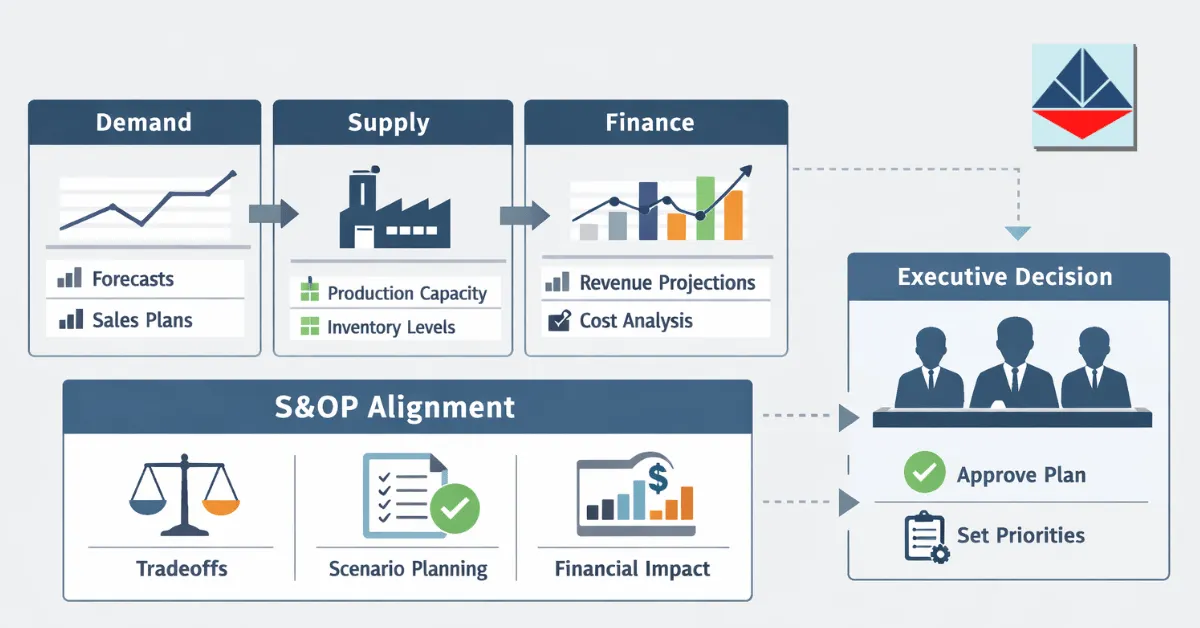
Sales and Operations Planning and Integrated Business Planning remain essential because organizations still need alignment around:
- Demand assumptions
- Financial priorities
- Inventory positioning
- Service expectations
- Capacity constraints
- Supply risk
- Decision escalation
The more AI enters planning, the more important governance, policy discipline, and exception management become.
AI can help organizations sense change faster. But leadership still needs a disciplined forum for deciding what matters most when the business cannot satisfy every objective at the same time.
That is why the next stage of planning is not simply more automation. It is better decision structure.
For a broader view of how planning can improve decision clarity and alignment, see Sales and Operations Planning Process: How to Improve Decision Clarity, Alignment, and Business Performance.
Data Quality Is Still the Overlooked Foundation
AI is only as reliable as the data feeding it.
Many organizations underestimate how poor data quality undermines intelligent automation.
Poor master data creates:
- Incorrect forecasts
- Broken replenishment logic
- Supplier inaccuracies
- Inventory instability
- Faulty recommendations
- Weak trust in system outputs
- Poor exception prioritization
ERP systems contain valuable transactional data:
- Orders
- Inventory balances
- Purchase orders
- Vendor records
- Financial transactions
- Production records
But intelligent supply chain execution often requires more context:
- Lead-time variability
- Supplier reliability
- Capacity constraints
- Transportation delays
- Promotion calendars
- Inventory segmentation
- Exception history
- Customer priority rules
- Cost-to-serve logic
- Service commitments
Without this operational layer, AI may generate recommendations that appear intelligent while remaining disconnected from execution reality.
AI-powered ERP built on weak data becomes a faster way to scale confusion.
Agentic AI Raises the Stakes. It Does Not Remove the Need for Strategy.
The market is now shifting from AI assistants toward agentic AI systems capable of taking action autonomously.
That changes the risk profile significantly.
An AI assistant may recommend inventory adjustments.
An AI agent may directly trigger purchase orders, reroute transportation, update replenishment settings, or execute operational workflows automatically.
Once AI systems begin acting independently, organizations must define:
- What AI agents can execute autonomously
- What requires human approval
- Which decisions should never be delegated
- What audit controls are required
- How errors are detected
- Who owns the outcome
- How business rules are updated
- How exceptions are escalated
- How drift is monitored
“Human-in-the-loop” cannot be treated as a slogan. It must be intentionally designed into the operating model.
As AI becomes more autonomous, supply chain leaders need a control tower mindset focused on visibility, governance, exception management, escalation control, and operational accountability.
Agentic AI without governance is not autonomy.
It is operational risk with a better interface.
Where the Glass Cockpit Approach Fits
In EFGC’s broader point of view, better outcomes come from better decision clarity, stronger controls, and closer alignment between supply chain actions and business priorities. The PROFITABILITY NOW book reflects that perspective through the Glass Cockpit approach.
The goal is not more system activity.
The goal is a clearer decision environment where visibility, control, inventory discipline, and business outcomes can be managed together.
That is the difference between adding AI to an ERP workflow and building supply chain intelligence that helps leaders see what is happening, understand what matters, and act with stronger business alignment.
What a Real AI Supply Chain Strategy Should Include
Most organizations are asking the same question:
“So what should we do instead?”
The answer is not avoiding AI.
The answer is treating AI as part of an operating-model transformation instead of a software rollout.
A practical AI supply chain strategy should include:
- Clear business problem definition
- Decision mapping by function
- Data readiness assessment
- AI use-case prioritization
- Human-in-the-loop governance
- Workflow integration planning
- Risk and cybersecurity review
- Talent and training development
- ROI and ROCE measurement frameworks
- Continuous improvement processes
- Post-launch ownership of models, rules, and exceptions
Most importantly, AI initiatives should connect directly to business value:
- Customer service
- Inventory health
- Cost-to-serve
- Working capital
- Margin
- Operational resilience
- Response speed
- ROCE
A real AI strategy does not start with:
“What does the ERP vendor offer?”
It starts with:
“Which supply chain decisions must become faster, better, and more profitable?”
For leadership teams and learning environments that need to make these tradeoffs more visible, the ROCE Business Game is designed to show how disruptions, siloed responses, and AI-supported decision paths affect ROCE, working capital, and broader business performance.
Practical Questions Executives Should Ask Before Treating AI-Powered ERP as Strategy
Before approving AI-powered ERP as a transformation program, executives should ask:
- Which supply chain decisions are we trying to improve?
- Which business outcomes should change?
- Where are our current visibility and control gaps?
- Which decisions are slowed by unclear ownership?
- Which data inputs are trusted enough for automation?
- Which recommendations require human approval?
- How will we measure impact on service, cost, inventory, working capital, margin, and ROCE?
- Who owns the operating model after go-live?
- How will business rules be updated when market conditions change?
- What happens when AI recommendations conflict with commercial or financial priorities?
If these questions cannot be answered clearly, the organization is not ready to treat AI-powered ERP as a strategy.
It may be ready for a software upgrade.
That is not the same thing.
Conclusion
AI-powered ERP will matter.
It can improve workflows, automate repetitive tasks, accelerate exception handling, and increase visibility across the enterprise.
But it is not, by itself, a supply chain strategy.
The companies that succeed will understand the difference between a system upgrade and an operating-model upgrade.
They will use AI to strengthen planning discipline, improve exception management, sharpen inventory decisions, enhance supplier visibility, and connect operational execution directly to profitability.
The companies that fail will buy AI-powered ERP, declare transformation complete, and then wonder why they still struggle with excess inventory, late orders, planner burnout, weak forecast trust, and siloed accountability.
Because the real challenge was never the absence of AI.
It was the absence of operational clarity.
Technology may accelerate the supply chain.
But strategy still decides where it goes.
For organizations that need clearer diagnosis, stronger visibility, tighter controls, and more business-aligned supply chain decisions, explore EFGC’s AI for supply chain management solutions or contact Eighty Four Group Consulting to discuss the right next step.